Ffellonics as a Research Framework for AI Architecture
A Proposal for Geometric Constraints in Relational Intelligence Systems
As AI systems grow larger, a cluster of persistent failure modes remains stubbornly resistant to scale alone: representational drift under distributional shift, fragility under compositional stress, and the absence of stable hierarchical structure that would allow a system to know how well it has organised its representations at any given time. These are not simply problems of insufficient data or parameters. They suggest something is missing at the architectural level — a principled geometric constraint on how representations should relate to one another.
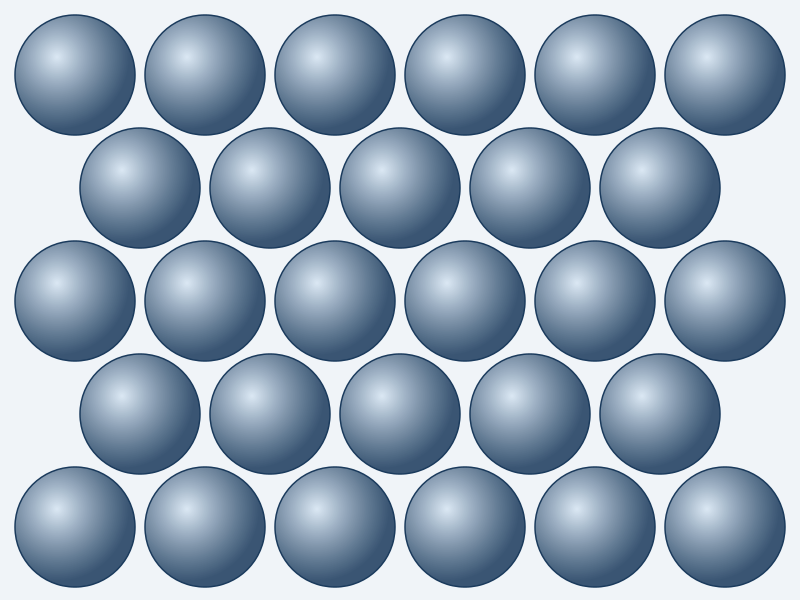
Ffellonics is a 12-level reference model of relational emergence, based on the self-organisation of identical spherical units under a single local rule: symmetric nearest-neighbor attachment under thermodynamic free-energy minimisation. From this one rule, a deterministic hierarchy of stable coordination structures emerges — from a dyad at Level 1 through the Platonic solids at Levels 3–5 to the 12-fold FCC/HCP lattice at Level 12, the kissing-number ground state in three dimensions. What follows is a research proposal: that Ffellonics, or a formalisation of its principles, could supply a geometric prior for AI architectures — not as a replacement for statistical learning, but as a constraint that gives learned representations a lawful attractor structure to converge toward.
These are hypotheses, not results. The aim here is to state them precisely enough to be tested.
The Core Observation
Current deep learning architectures impose constraints on representations primarily through loss functions and layer topology. What they do not impose is a constraint on the relational geometry of learned representations — how units should coordinate with their neighbours, how many neighbours are optimal, and what a stable relational ground state looks like. Ffellonics provides exactly this: a concrete, mathematically grounded description of what maximally efficient relational coordination looks like, with a finite hierarchical path to reach it.
The hypothesis is that architectures constrained to approximate Ffellonic coordination geometry would exhibit more stable, interpretable, and hierarchically coherent representations than unconstrained equivalents. This is an empirical claim and should be treated as one.
Two Concrete Research Proposals
1. Symmetry-Equivariant Graph Neural Networks with Ffellonic Coordination Constraints
Symmetry-equivariant neural networks — architectures whose outputs transform predictably under input symmetries — are an active and productive research area. E(3)-equivariant networks for molecular property prediction (e.g., SE(3)-Transformers, SEGNN, NequIP) have demonstrated that enforcing geometric symmetry constraints produces significantly more data-efficient and generalisable models in physical domains.
The specific proposal is to design graph neural networks in which the message-passing architecture enforces coordination geometry consistent with Ffellonic levels. Concretely:
The attention mechanism would reward edges that contribute to locally symmetric coordination shells, penalising configurations that deviate from the nearest stable Ffellonic level.
The aggregation function would be defined not over arbitrary neighbourhoods but over coordination shells with explicitly tracked symmetry order.
The depth of the network would correspond to hierarchical progression through coordination levels, with each layer stabilising the previous level's geometry before adding the next.
What would count as confirmation: A GNN with these constraints outperforming an unconstrained baseline of equivalent parameter count on tasks requiring hierarchical relational structure — molecular graph classification, scene graph understanding, or multi-hop reasoning — with measurably more stable intermediate representations under input perturbation.
What would count as falsification: No measurable improvement, or improvement attributable to the coordination constraint being equivalent to simpler regularisation already in use.
2. The Ffellonic Evaluation Scaffold
One of the persistent difficulties in AI evaluation is that behavioural benchmarks test outputs without revealing how a model has organised its internal representations. A Ffellonic evaluation scaffold would offer a structural diagnostic: at each layer of a trained network, measure the degree to which the representational geometry approximates successive Ffellonic coordination levels.
Operationally, this would require:
A metric for "coordination number" in representation space — the number of nearest neighbours in activation space that a given unit reliably co-activates with.
A symmetry measure for those neighbour relationships — whether the coordination is isotropically distributed or clustered.
A progression metric — whether deeper layers consistently show higher coordination numbers and greater symmetry than shallower layers.
This scaffold would be model-agnostic: it can be applied post-hoc to any trained architecture. The research question is whether networks that score higher on the Ffellonic progression metric also exhibit better generalisation, robustness, or interpretability on downstream tasks.
What would count as confirmation: A reliable positive correlation between Ffellonic progression scores and independent performance metrics across a range of architectures and tasks.
What would count as falsification: No correlation, or correlation that disappears after controlling for standard measures like effective rank or intrinsic dimensionality of representations.
Additional Directions Worth Exploring
Beyond the two primary proposals, two further directions have structural motivation from Ffellonics, though they are at an earlier stage of formulation.
Self-organising multi-agent systems. Ffellonics describes a local rule by which identical agents, following only nearest-neighbour coordination, converge to a globally stable collective structure. Applied to multi-agent reinforcement learning or mixture-of-experts systems, this suggests a coordination reward based on local relational symmetry rather than global task performance. The hypothesis is that agents trained with such a reward would self-organise into more stable and bandwidth-efficient communication topologies than agents trained with communication cost alone.
Geometric regularisation of loss landscapes. Traditional loss functions are defined over output quality without constraints on the geometry of the path taken through parameter space. A Ffellonic regularisation term would penalise representations that sit in metastable configurations — high local coordination variance — rewarding convergence toward stable symmetric shells. This is related to, but distinct from, existing work on loss landscape geometry; the distinction is the explicit use of discrete coordination levels as targets rather than continuous smoothness criteria.
What Ffellonics Does Not Claim to Provide
Three strong claims that have appeared in discussions of Ffellonics and AI should be clearly distinguished from the proposals above.
First, the claim that enforcing Ffellonic structure would reduce hallucinations. Hallucinations in language models arise from the model generating statistically plausible but factually ungrounded text — a problem of factual grounding, not geometric representational structure. There is no established causal chain from coordination geometry to reduced hallucinations, and this claim should not be made until a mechanism is specified and tested.
Second, the claim that alignment would become "the thermodynamic outcome of the architecture itself." Alignment is a deep and difficult problem. A geometry that produces coherent internal representations is a necessary but nowhere near sufficient condition for aligned behaviour. This claim requires substantial independent argument.
Third, the connection to Friston's Free Energy Principle: Friston's variational free energy is an information-theoretic quantity defined over probability distributions — distinct from the thermodynamic Gibbs free energy that drives Ffellonic self-assembly. The two share structural analogies but should not be conflated. Any proposal to connect Ffellonics to predictive coding architectures would need to bridge this gap explicitly.
Open Problems
The primary engineering challenges are:
Defining "coordination level" for continuous high-dimensional activation spaces in a way that is computationally tractable at scale.
Establishing whether the discrete snapping behaviour of Ffellonic levels survives the introduction of noise and stochasticity inherent in gradient-based training.
Designing experiments with sufficient statistical power to distinguish Ffellonic effects from existing geometric regularisation techniques.
These are genuine open problems. They are also well-posed enough to be worked on. The value of the framework at this stage is that it supplies specific, falsifiable hypotheses — a map to the questions, not yet to the answers.
Conclusion
Ffellonics offers AI architecture research a geometrically grounded, physically motivated prior for what stable relational organisation looks like and how it is reached. Its value is not as a replacement for statistical learning but as a source of principled constraints that give learned representations a lawful attractor to converge toward.
The two proposals above — symmetry-equivariant GNNs with Ffellonic coordination constraints, and the Ffellonic evaluation scaffold — are concrete enough to implement and falsifiable enough to test. If they bear out empirically, they would provide the first evidence that the Ffellonic hierarchy is not merely a geometric reference model but a productive design principle for artificial intelligence systems. If they don't, that failure would itself be informative about the limits of the framework's applicability.
That is the appropriate epistemic posture for a framework at this stage: precise enough to be wrong, and worth finding out.
Comments
No comments yet. Be the first to share your thoughts.