
Ffellonics: Range, Temperature and Binding Capacity
The conditions under which the single local rule of Ffellonics plays out
14 Oct 2026 · @David Fell
The puzzle
The single local rule of Ffellonics says that identical spheres attach where they make the most contacts, in the most symmetric arrangement available, so that free energy falls. Applied repeatedly, it builds the Ffellonic Hierarchy, a twelve-level developmental progression from the first contact between two spheres to close packing. A structure's level is the number of neighbours each sphere touches: the octahedron is Level 4, the hollow icosahedron Level 5.
Experiments seem to disagree. Six colloidal spheres with short-range attraction more often form the less symmetric polytetrahedron than the octahedron (Meng et al. 2010), and the lowest-energy twelve-sphere clusters are close-packed fragments, not icosahedra (Arkus et al. 2009).
Either the rule is wrong, or it has been stated without its conditions. This essay argues for the second. The rule acts under three conditions that work like dials: the range of the attraction, the temperature, and the binding capacity of each sphere. Set differently, they select different structures, in ways that can be calculated and checked.
Energy against entropy
Which structure a cluster settles into is decided by its free energy, G = H − TS. Energy favours contacts: each touching pair lowers H, so the arrangement with more contacts wins, other things equal. Entropy can favour the less symmetric: a highly symmetric cluster can be reached in fewer distinct ways, so its rotational entropy is lower. The octahedron has 48 symmetry operations, the polytetrahedron only 4. Floppy structures also carry more vibrational entropy than rigid ones.
Temperature sets the exchange rate. At low temperature energy dominates; at high temperature entropy does. Between them lies a crossover temperature, which exists only when energy and entropy pull in opposite directions. The rule's symmetry clause is therefore a claim about energy: where the symmetric arrangement also has lower energy, it wins below the crossover; where it only ties, entropy decides against it.
The first dial: range
Six spheres are the first point in the hierarchy where two structures compete: the octahedron (Level 4) and the polytetrahedron both make twelve contacts. I modelled the attraction with the Morse potential, whose range is set by one parameter ρ (small ρ = long range), relaxed both clusters, and found the temperature at which they swap. There are three regimes.
Long range (ρ ≤ about 4): the octahedron has no rival. The polytetrahedron is not even stable; started in that shape, it relaxes into the octahedron.
Intermediate range (ρ ≈ 5 to 14): energy against entropy. The octahedron's next-nearest neighbours sit closer, so it is lower in energy and wins below a crossover temperature that falls steeply as the range shortens.
Short range (ρ ≥ about 30): a tie that entropy settles. The energies are identical, and the polytetrahedron is favoured about 24 to 1 on symmetry alone. This is the regime of the colloids Meng et al. measured.
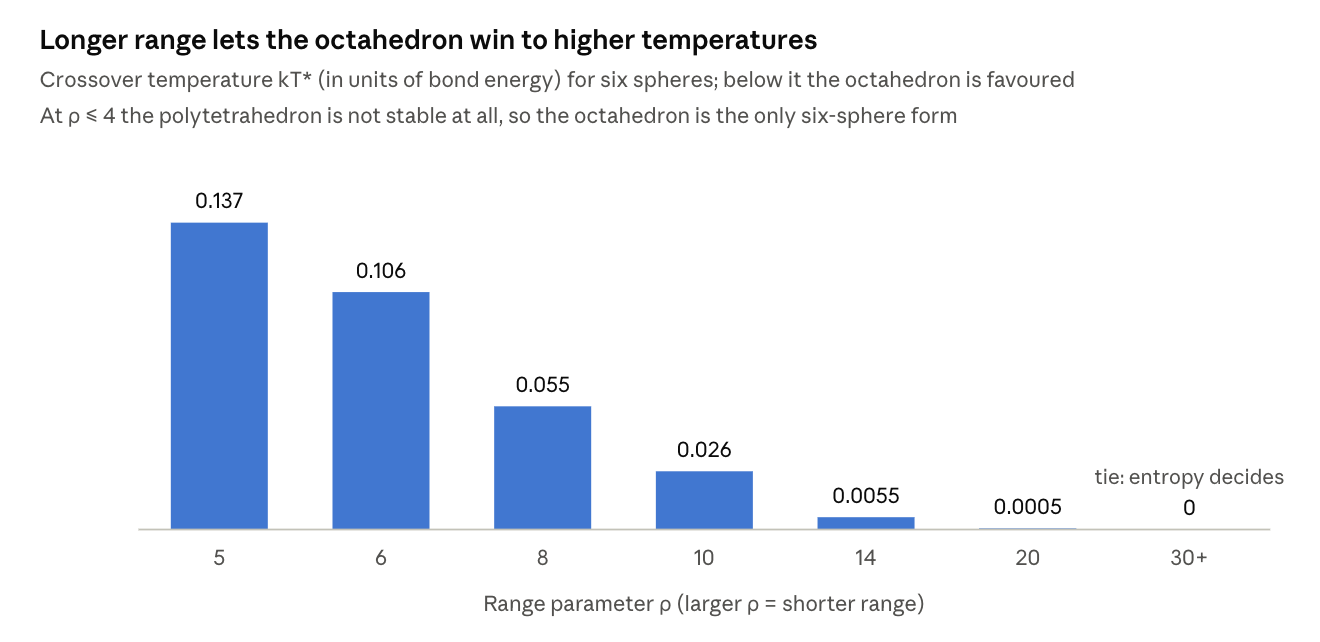
ρ = 6 matches the Lennard-Jones potential used for simple atoms; ρ ≈ 14 was used by Doye, Wales and Berry (1995) to represent C60 molecules. The octahedron is the expected six-sphere structure for atom-like attraction. The colloid result does not contradict Level 4; it marks the edge of the conditions under which Level 4 appears.
The second dial: binding capacity
The Ffellonic icosahedron is hollow: twelve spheres on a shell, each touching five neighbours, thirty contacts, nothing at the centre.
With unlimited binding, it never wins. At short range a fragment of the hexagonal close-packed (HCP) lattice beats it with 33 contacts to 30; at longer range a centred arrangement that fills the hollow wins. Arkus et al. (2009) found independently that twelve-sphere ground states are close-packed fragments. Entropy does not help: with 120 symmetry operations the icosahedron carries the largest symmetry penalty, so energy and entropy both work against it and no crossover exists.
With a binding capacity of five, the result reverses. If each sphere can hold at most five bonds, twelve spheres can make at most thirty. The hollow icosahedron reaches that ceiling exactly, in one rigid arrangement. Close-packed fragments cannot: their spheres have uneven neighbour counts, so the cap wastes the surplus and cannot fill the shortfall. Across about 440 fragments, none made more than 28 capped bonds.
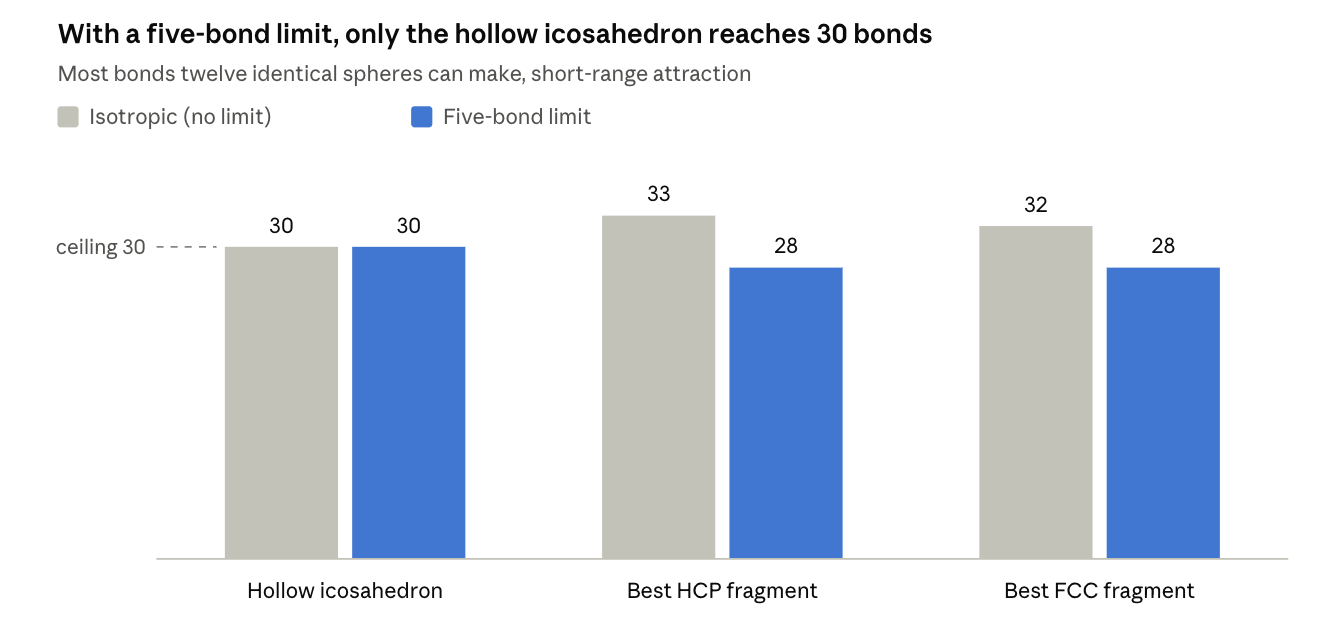
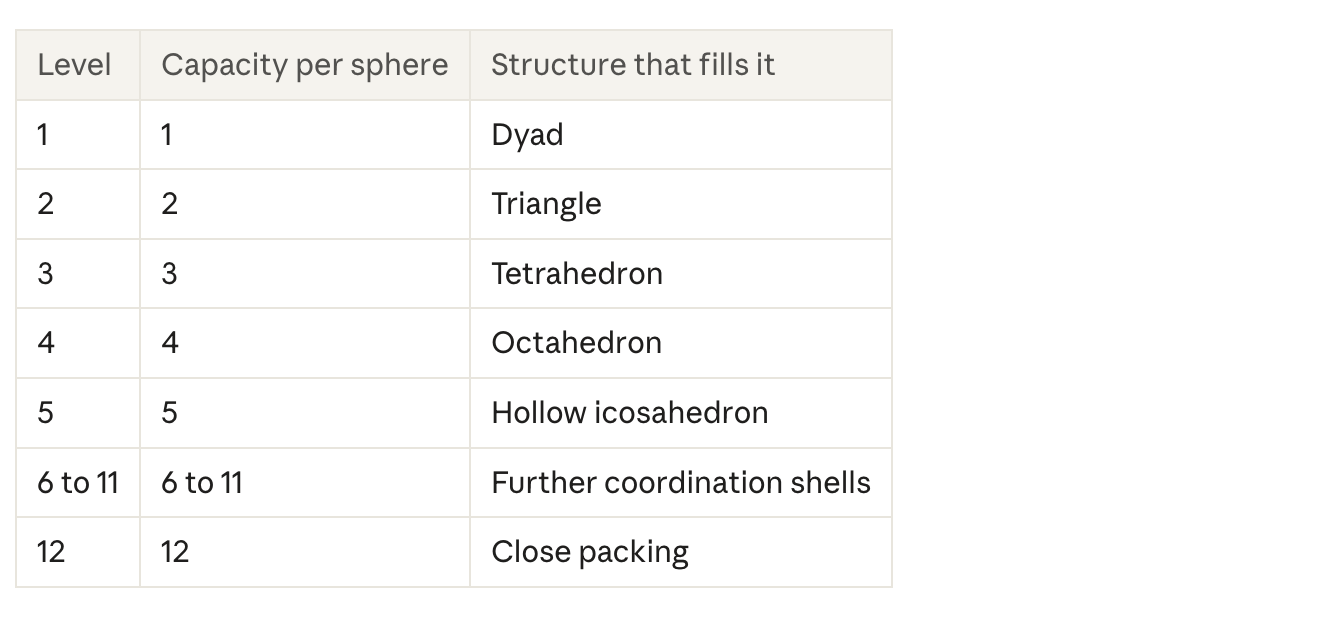
The rule then reads: attach where contacts are maximised, up to the sphere's binding capacity. A level is defined by the neighbours each sphere touches, and that number is now also the capacity that selects the structure.
Level 4 passes the test. With a four-bond cap, the octahedron makes all twelve possible bonds rigidly; the polytetrahedron, with two five-neighbour spheres, is trimmed to eleven and is no longer rigid. The octahedron wins on energy at any range, and Meng et al.'s colloids become spheres whose capacity is above four. Level 5 passes, as shown above. Level 12 joins the isotropic case: twelve is the most neighbours an equal sphere can have, so a capacity of twelve is no limit at all. The isotropic baseline is the ladder's top rung, not a competitor.
Some things hold at every setting. Levels 1 to 3 have only one contact-maximising arrangement each, so the dials cannot change them. The direction always runs towards more contacts per sphere: the dials shape the route, not the heading, and the hierarchy remains a developmental progression that moves in one direction only. And every range of isotropic attraction ends in the bulk in a twelve-coordinated lattice, face-centred cubic or hexagonal close-packed.
Crystal chemistry offers a partial precedent: in Pauling's radius-ratio rules, an ion's number of neighbours steps up through 3, 4, 6, 8 and 12 as its relative size grows. Pauling counts around a central ion, unlike the Ffellonic levels, but a capacity rising in steps is ordinary physics.
Equilibrium, not pathway
Every calculation here asks which arrangement of a fixed number of spheres has the lowest free energy, or the most bonds under a cap. That is a question about equilibrium, not about how assembly proceeds, and the two can come apart.
Real assembly runs over time. Moving from one arrangement to another means breaking bonds and crossing an energy barrier; where barriers are high, a cluster can be trapped in whatever formed first. Rapidly cooled liquids freeze into glasses this way, and local icosahedral order can delay crystallisation (Frank 1952). Ostwald's step rule records that less stable forms often appear before the most stable one, and small colloidal clusters have been watched hopping between free-energy minima with measurable lifetimes (Perry et al. 2012).
There is also a tension inside the framework. The rule is stated as sequential attachment, each contact locked in as it forms; the equilibrium calculations assume bonds break and re-form freely. The two agree only when attachment is slow, reversible, or followed by annealing.
The results here are therefore equilibrium results. They say which structure a slowly assembled, reversibly bonded system should end up in, not which forms first or whether a fast, irreversible process reaches it. Thermodynamics sets the destination; kinetics decides whether and how it is reached. The kinetic half of the hierarchy (barriers between levels, pathways from one to the next, and when sequential locking-in still finds the equilibrium structure) is not addressed here.
Predictions, and what would count against them
These are equilibrium predictions: they describe what assembly reaches when bonds can break and re-form, not what forms first.
Six spheres with long-range or four-capacity binding form octahedra at low temperature, not polytetrahedra.
The octahedron's advantage shrinks as range shortens, with a crossover temperature that falls steeply between ρ ≈ 5 and 14 and vanishes for colloid-like attraction.
Twelve spheres that can each bind exactly five neighbours form hollow icosahedra at low temperature; twelve isotropic spheres form close-packed fragments.
Raising temperature moves clusters towards less symmetric, floppier forms, never more symmetric ones.
The rule as stated here would be undermined by five-capacity particles that reliably settle into something other than icosahedra at equilibrium, by long-range six-sphere clusters that settle into polytetrahedra at low temperature, or by a level that is not the equilibrium structure at any setting of the three dials.
Open questions
What makes capacity rise? A rise in binding energy, a change in the units as they combine, or something else. This is the first question a physicist will ask.
Do Levels 6 to 11 each have a unique structure? Capacities 1 to 5 are settled; 6 to 11 are open and computable.
Where exactly is the five-bond crossover? A model with explicit bond directions would place it.
Are there non-lattice rivals? A thirty-bond rival would need every sphere to touch exactly five others; the icosahedron is the natural candidate, but its uniqueness is not proved here.
Methods
The calculations are original and unpublished, offered as reproducible work with the scripts available. six_sphere_crossover.py and twelve_sphere_crossover.py relax candidate clusters under the Morse potential and compare them in the harmonic approximation (energies, vibrations, moments of inertia, symmetry numbers), which is most reliable at low temperature. valence5_twelve.py counts the most bonds each structure can hold under a per-sphere cap, and whether those bond sets are rigid. All three compare structures at equilibrium; none simulates assembly over time. Where a published result covers the same ground, the essay rests on it first.
References
Arkus, N., Manoharan, V. N. and Brenner, M. P. (2009). Minimal energy clusters of hard spheres with short range attractions. Physical Review Letters 103, 118303.
Doye, J. P. K., Wales, D. J. and Berry, R. S. (1995). The effect of the range of the potential on the structures of clusters. Journal of Chemical Physics 103, 4234–4249.
Frank, F. C. (1952). Supercooling of liquids. Proceedings of the Royal Society A 215, 43–46.
Meng, G., Arkus, N., Brenner, M. P. and Manoharan, V. N. (2010). The free-energy landscape of clusters of attractive hard spheres. Science 327, 560–563.
Ostwald, W. (1897). Studien über die Bildung und Umwandlung fester Körper. Zeitschrift für physikalische Chemie 22, 289–330.
Pauling, L. (1929). The principles determining the structure of complex ionic crystals. Journal of the American Chemical Society 51, 1010–1026. Summary: Pauling's rules.
Perry, R. W., Meng, G., Dimiduk, T. G., Fung, J. and Manoharan, V. N. (2012). Real-space studies of the structure and dynamics of self-assembled colloidal clusters. Faraday Discussions 159, 211–234.
Wang, Y. et al. (2012). Colloids with valence and specific directional bonding. Nature 491, 51–55.
Comments
No comments yet. Be the first to share your thoughts.