How Ffellonic Geometry Maps Nature's Efficient Structures
How Ffellonic Geometry Maps Nature's Efficient Structures
Look at the world and the same things keep appearing: cycles, stages, branching, hierarchy. Rivers divide into tributaries. Stars pass through phases. Ecosystems grow, break down and renew. A seed becomes a tree one stage at a time. These patterns suggest an underlying order, and the question is what kind of order it is.
A quiet way of working
Taoist writing has a name for the feeling these processes give: wu wei, action without strain. Water goes around the rock, not through it. Nothing is forced, yet a great deal changes.
It is a good image, and it points at something real. Nature rarely moves by shoving. Much of what we see is the result of small, steady adjustments that add up. Physics gives us a few precise ways to say this, and they are worth stating carefully, because the careful version is more interesting than the loose one.
What physics actually says
Least action. Real trajectories make a quantity called the action stationary. That means small changes to the path leave it unchanged to first order. Often this is a minimum, but not always, and the action is not "effort" or "energy over time". It is a precise quantity built from kinetic and potential energy along a path.
Quantum mechanics. A particle's behaviour can be calculated by summing over all possible paths. Paths that are far from stationary cancel each other out, and the classical path is what remains. This is not the absence of force. It is interference doing the selecting.
Equilibrium. Systems that can rearrange at constant temperature and pressure settle toward lower Gibbs free energy. This is a different principle from least action, but it belongs to the same family: nature often sits where some quantity is stationary or lowest.
Thermodynamics tells us the direction. It does not tell us the pace, which depends on supply, diffusion and barriers. A process can head for the same destination quickly or slowly, and quietly in either case.
The geometry of economy
Several familiar shapes come from such trade-offs:
The brachistochrone is the curve of fastest descent under gravity. It is a cycloid, curved yet quickest.
Soap films on a wire frame settle into minimal surfaces, which have zero mean curvature. A soap bubble is a related but different case: it encloses a volume, and its curvature is constant, not zero.
Branching networks in trees, lungs and river basins resemble self-similar patterns, though real ones are only approximately fractal.
Logarithmic spirals, as in the nautilus shell, keep their shape as they grow.
None of these says nature is effortless. They show that when a system has a rule and a constraint, a simple geometry often follows.
Ffellonic geometry: spheres and what they touch
Ffellonic geometry begins with the simplest unit: identical spheres in three dimensions. The question is which spheres touch which. Let spheres attach to their nearest neighbours in ways that lower free energy, and structures with symmetry appear.
The framework organises these structures into twelve levels, where the level is the number of neighbours each sphere has:
Level 1 is a pair of touching spheres, and Level 2 is a triangle.
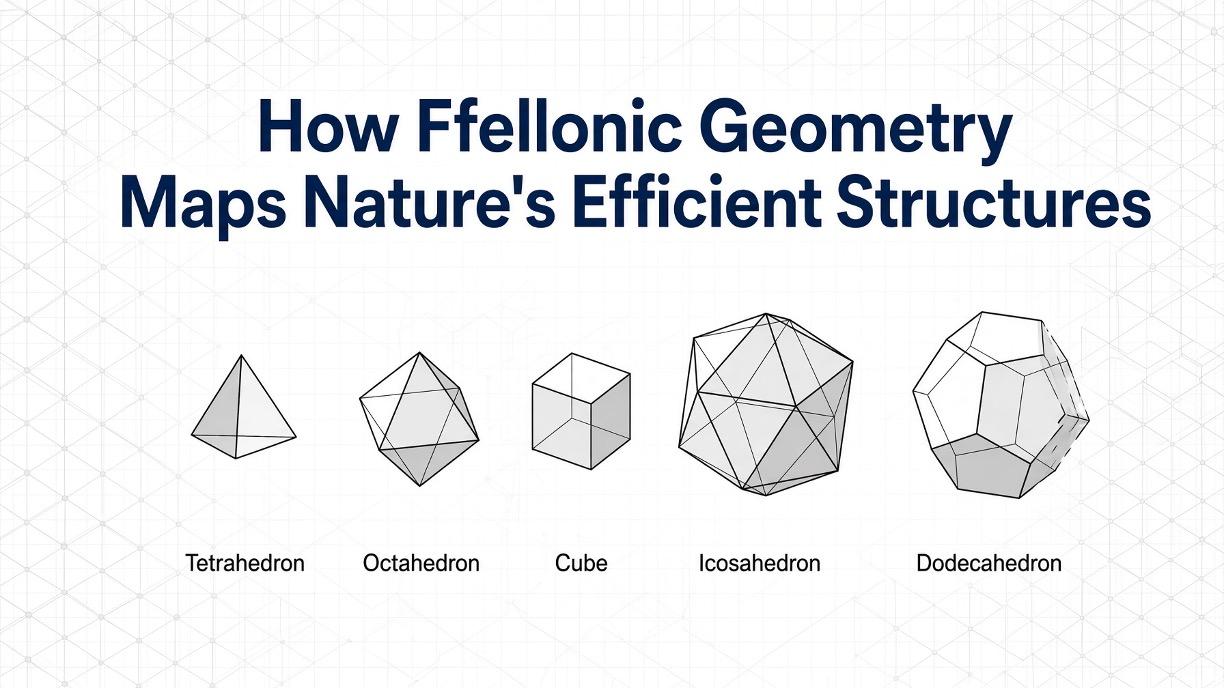
Level 3 is the tetrahedron, with three neighbours each. Level 4 is the octahedron, with four.
Level 5 is a hollow icosahedron, with five neighbours each.
Levels 6 and above lead through planes, beams and denser frames to Level 12, which is a class of maximally coordinated lattices, FCC and HCP, and not a single structure.
The Platonic solids appear along the way, but in two ways. Joining the centres of touching spheres gives the tetrahedron, octahedron and icosahedron. The cube and dodecahedron come from the gaps. Where three spheres touch, their radical planes meet at a point in the gap between them, outside all three spheres. Those points are the corners of the dual solid, so the cube and dodecahedron are written into the same spheres. Geometry here is a map, and the terrain is spheres in contact.
Where it lines up with nature
Some matches are at the level of mechanism. Metals crystallise into FCC or HCP. Colloidal spheres with short-range attraction assemble into clusters that researchers can now count and compare. Icosahedral shells recur in virus capsids. In these cases something close to the Ffellonic rule is plausibly at work.
Other resemblances are in shape only, and the framework should not claim them as evidence. The same goes for social bonds and ecological hierarchies. These are analogies, and they are suggestive, but they are not tests.
What it does not claim
The levels are rungs of binding capacity, not a sequence nature must follow. Results describe equilibrium, not the pathway taken.
What drives binding capacity upward is an open question.
Real systems depart from the model through anisotropy, strain, kinetics, entropy-driven ordering, arrest and regulation. Those departures are informative, not failures.
The levels are not guaranteed free-energy minima. At six spheres, for example, an octahedron and a polytetrahedron compete, and which one dominates depends on capacity and entropy.
Evidence against would be, for instance, isotropic short-range systems that regularly and reproducibly settle into structures the levels cannot account for.
Standing on shoulders
Kepler studied sphere packing. Fuller explored the isotropic vector matrix. Frank connected icosahedral order to dense liquids. Researchers on sticky-sphere clusters, among them Arkus, Manoharan, Brenner and Holmes-Cerfon, have mapped what small groups of spheres do. Ffellonics offers a way to read these results as one ladder.
An invitation
Ffellonic geometry may be most useful as a reference model: a baseline of identical units, isotropic short-range attraction and free rearrangement. Start there, and every departure tells you something. If you work with clusters, colloids, packings or lattices, the most useful response is a counterexample or a measurement. How far does a simple rule go, and where does it stop?
Comments
No comments yet. Be the first to share your thoughts.