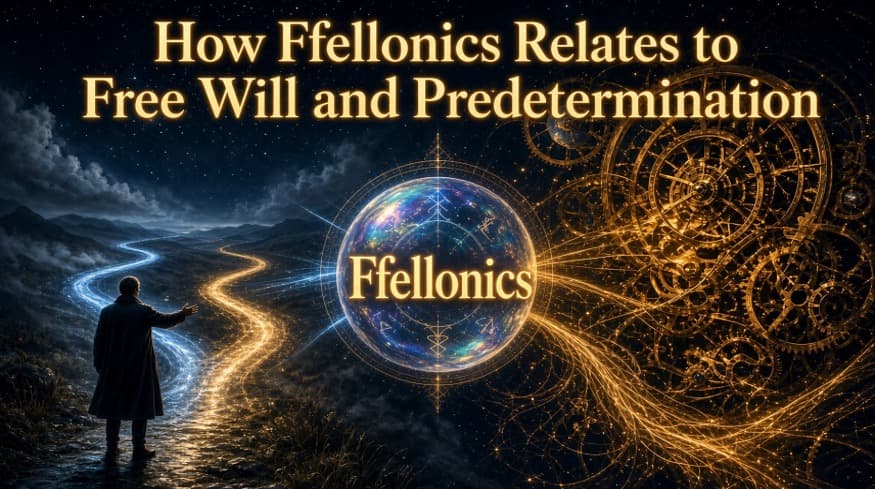
How Ffellonics Relates to Free Will and Predetermination
Ffellonics, the geometric framework developed by David Fell and presented on ffell.com, does not enter the classical theological debate between libertarian free will and divine predestination. It recasts a nearby tension in thermodynamic, geometric, and relational terms: strong immanent necessity on one side, and a felt sense of participation that becomes available only at higher levels of organization on the other. Predetermination is the better word for that necessity. Predestination names a different claim.
This reading is stricter than some of the framework's own sentences. Ffellonics texts speak of "implicit destiny" and sometimes of immanent teleology. What follows keeps the mechanism and tightens the vocabulary around it.
The Core Model: One Rule, a Fixed Hierarchy
Ffellonics begins with identical spherical units in pre-relational isolation — pure potential without structure, identity, or meaning. The moment two units make contact ("the first ontological touch"), a single local rule activates: attach symmetrically to nearest neighbors in the position that maximizes contacts while minimizing Gibbs free energy. From that irreversible event, a deterministic twelve-level hierarchy unfolds:
Level 1: dyad
Level 2: triangle
Level 3: tetrahedron (first Platonic solid)
Intermediate levels: further Platonic and Archimedean forms and coordination shells
Level 12: a dense FCC/HCP lattice of 12-fold coordination — the kissing-number maximum in three-dimensional space, and the configuration toward which free-energy minimization drives the system
No external blueprint, designer, or long-range force is required. The process is bottom-up, dissipative, and irreversible. Higher-order patterns — symmetry, coherence, even consciousness — are treated as weak emergence: in principle fully derivable from repeated application of the local rule plus energy minimization, with no additional causal powers entering at any level.
One physical caveat: while FCC is often treated as the ground state for hard-sphere packing, the free-energy difference between FCC and HCP is extremely small in the colloidal-physics literature. Which packing is favored remains a live question. Treating Level 12 as the class of maximal 12-fold coordination is defensible; claiming a single, sharply preferred ground state overstates what the physics currently guarantees. The argument below needs only that some maximal-coordination state is the attractor.
Why "Predetermination" Fits and "Predestination" Only Partly Does
Classical predestination is a doctrine of election. Its stakes rest on the asymmetry between who is chosen and who is not. Ffellonics makes no claim of that kind. What is fixed is the structure of the hierarchy: any system of identical units, given the local rule, converges on the same terminal architecture. No sphere is elected over another; no individual fate is singled out.
That is predetermination of form, not predestination of persons. It is closer to natural law or a teleonomic attractor than to theological election. It specifies a shape reality tends toward, not a fate assigned to particular relata.
The weaker claim still has content. From the first bond, the path toward maximum relational coordination is latent in the rule. Nothing external needs to intervene for the hierarchy to complete itself. Isolated units possess no destiny; relation encodes the outcome. There is no transcendent electing will — only the geometry of contact and the physics of energy minimization. In that qualified sense, the overall form of reality — order, coordination, and the possibility of consciousness — is predetermined the instant relation begins. This holds for the identical-sphere idealization. If the model were later applied to non-identical agents, the election analogy could return; it does not apply here.
Necessity, Teleonomy, and Direction
Ffellonics aligns with philosophies that treat freedom as insight into necessity rather than as undetermined alternative possibility — most clearly Spinoza, for whom conventional free will is rejected and freedom consists in understanding the necessity of a rationally ordered universe. The unfolding also resembles a geometric diagram of Hegelian dialectic: each stage arises from the previous through internal necessity. Spinoza does the real work; the Hegel parallel is resemblance, not identity.
Two concepts of end-directedness should not be collapsed. Teleology implies a real pull from a future state: the end explains the means. Teleonomy, the term biologists use for apparent purposiveness, avoids that commitment. End-directed behavior is explained by prior causal structure, with no forward-reaching influence from the future state. Ffellonics' mechanism — local energy minimization, applied iteratively — is teleonomic, not teleological. Level 12 does not reach backward and shape earlier steps; it is where the local rule, applied repeatedly, terminates. "Immanent teleology" is evocative but claims more than the mechanism licenses. The honest description is teleonomic end-directedness: retrospectively coherent, prospectively blind.
There is no room in this model for libertarian free will — the capacity to have done otherwise, undetermined. The attachments that build the hierarchy are governed by the energy-minimizing rule. What looks like choice at the micro level is the local expression of the same necessity driving the sequence.
Consciousness and the Limits of "Participation"
Consciousness is not a primitive property of isolated units. It is treated as emerging with relational depth — the felt experience of a system becoming more integrated, symmetric, and internally coherent, with rudimentary reactivity at the lowest levels and more coordinated awareness as the lattice approaches Level 12. The geometry does not solve the hard problem. Weak emergence plus energy minimization does not by itself explain why there is anything it is like to be a Level-12 lattice. The developmental claim can stand without that implication.
Higher levels are sometimes described in participatory language — a system experiencing the process from the inside, or walking an already-written path "one conscious, symmetric attachment at a time." That sits in tension with weak emergence. If everything at every level is fully derivable from the base rule, "participation" at Level 12 cannot add causal powers that were absent at Level 1. It would be a longer computation. If participation names something qualitatively new, the framework needs an account of why weak emergence should produce that texture at all.
The more defensible reading, and the one closest to Spinoza, is the first. "Participation" names a change in the system's relationship to its own necessity. Nothing is added ontologically. At sufficient relational depth a system can, for the first time, understand and align with the necessity already governing it. That is insight, not agency.
What the Model Adds to Compatibilism
It is fair to ask whether this is anything more than compatibilism in a sphere-packing metaphor. It is, in one respect. Compatibilism is typically argued at the level of an already-formed agent: can that agent's choices be free though determined? Ffellonics locates the question inside a developmental hierarchy. The capacity to experience necessity as freedom is not available uniformly to all determined systems; it scales with relational depth. A dyad has no more capacity for that insight than a rock. A Level-12 lattice might — not because it has escaped determinism, but because it has enough internal coordination for the Spinozist move to be phenomenally available at all.
That is a substantive addition to bare compatibilism, even if it remains speculative and outside what the geometry alone can establish. It is a claim of a testable kind, if proxies for coordination and reportable insight can ever be defined. It is not yet a falsifiable result.
With that addition stated, the mapping is:
Predetermination (qualified): The terminal architecture — some state of maximal, symmetric coordination — is implicit from the first touch. The process toward it is lawful, irreversible, and teleonomically end-directed. This is a claim about the shape reality converges on, not about the fate of particular units.
Free will (qualified): There is no libertarian exemption from the rule anywhere in the hierarchy. What can be called "conscious attachment" is not a new causal power but an increase in a system's capacity to recognize and align with the necessity it was always subject to — freedom as insight, available only once sufficient relational depth exists.
The model does not resolve whether a personal God elects individuals or whether humans possess undetermined moral agency, and it should not be read as trying to. It relocates a nearby question into geometry and thermodynamics: reality is a self-assembling, teleonomic process whose terminal architecture is predetermined by a local rule, while the capacity to recognize that process as one's own is a late, depth-dependent achievement — not a break in the determinism, but a late-arriving mode of relating to it.
The ancient tension is not abolished. It is restated as the difference between a structural outcome latent in the first relation and an interpretive freedom — insight into necessity — that becomes possible only after enough subsequent relations have already occurred. The path is written. At sufficient coordination, a system can come to understand that it is walking it.
Comments
No comments yet. Be the first to share your thoughts.