Not Defined by Shape but by Attaching Spheres: how all five Platonic solids come from touching spheres
Not Defined by Shape but by Attaching Spheres
The Platonic solids are the purest examples of symmetry among polyhedra. Every face is the same, every corner is the same, and nothing else in solid geometry is quite as regular. For more than two thousand years they have drawn the attention of mathematicians, philosophers and artists.
Yet they are usually taught as a list. Draw the five, count the faces and edges, show that there can be no more. In that presentation shape seems to be the only thing that matters, and the solids become still, self-contained objects with no obvious link to anything in nature. Seen that way, a link to nature will not be found.
The solids as a stage in a process
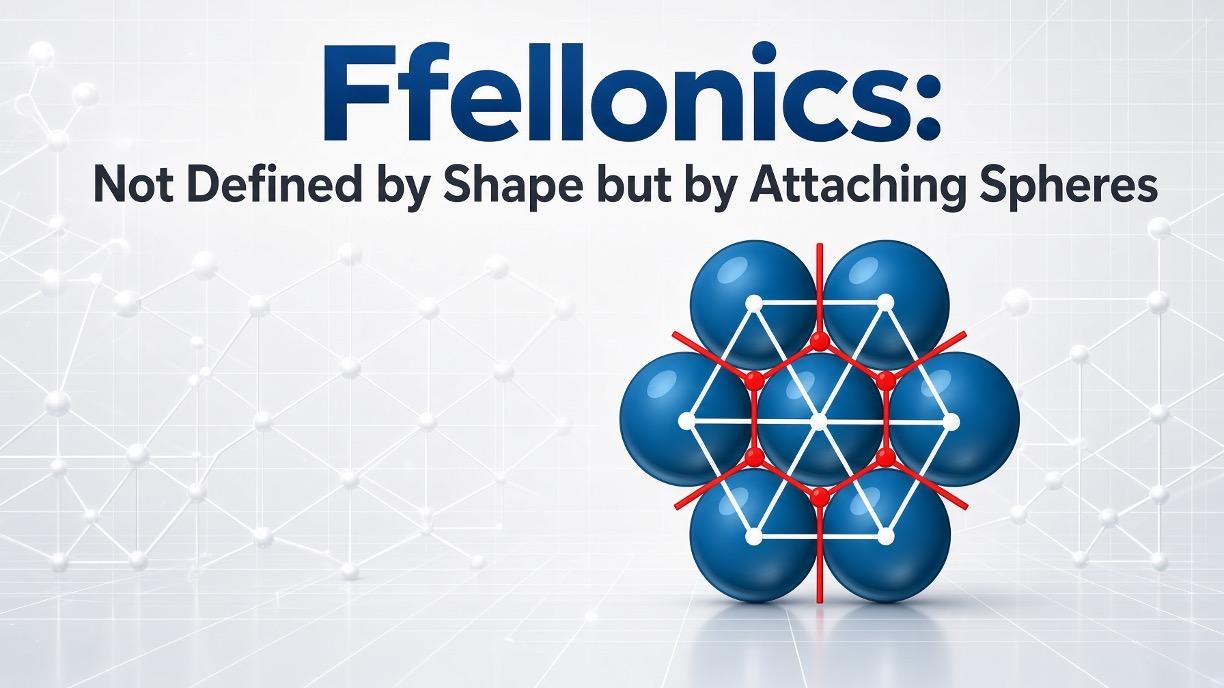
The dynamic side of the Platonic solids appears when we ask what they are based on. Ffellonics starts from identical spheres and one question: which spheres touch which? A structure is described by that pattern of contact, and the polyhedron is what the pattern looks like when you join the centres of the spheres.
Geometry is a tool for expressing natural patterns, in the way a map describes the terrain. Here the terrain is spheres in contact, and all five solids can be read off it in two ways.
Joining centres gives three.
Four touching spheres make a tetrahedron, with three contacts for each sphere.
Six make an octahedron, with four contacts each.
Twelve make a hollow icosahedron, with five contacts each and nothing at the centre.
Radical points give the duals. Every solid has a dual, and the dual is built from the same spheres. Where two spheres touch, the plane tangent to both at the contact point is their radical plane. Where three touching spheres meet, their three radical planes cross at a single point in the gap between them, outside all three spheres. This is the radical centre, and it sits at the centre of the face the three spheres make. Those points are the corners of the dual, and its edges pass through the contact points. The octahedron's dual is the cube, the icosahedron's is the dodecahedron, and the tetrahedron is its own dual. So the cube and dodecahedron are written into the same arrangement of spheres, in the empty space between them.
One distinction is worth stating. Spheres do not themselves settle into a cube or a dodecahedron, because spheres at those corners would barely touch and the cluster would not be rigid. Three of the five appear as clusters of touching spheres, and two appear as the pattern of radical points in the gaps between them. Either way, all five come from the same spheres.
These are not only paper constructions. Icosahedral shells are a recurring form in virus capsids, built from symmetric subunits (Caspar and Klug's work, from memory). Short-range icosahedral order appears in metallic liquids (Frank, 1952, also from memory). And researchers now build clusters of colloidal spheres in the lab and watch which shapes appear.
Plato himself did not treat the solids as inert. In the Timaeus, the solids built from the same triangles transform into one another, which is a first sketch of process (recalled, worth checking). The tradition has a dynamic strand, and Ffellonics continues it.
Past the solids there is no polyhedron left
The Platonic solids are early rungs. Level 6 is a flat sheet of spheres in a triangular pattern that goes on without end. Level 7 is an endless line of spheres supported by neighbours, a beam made of tetrahedra and octahedra. At the top, in the close-packed lattices of Level 12, every sphere touches twelve others and the structure fills space. A description built on polyhedra runs out at Level 5. A description built on contact carries on to the end, so the solids are milestones, not endpoints.
The parameter that makes it work: binding capacity
If spheres attract without limit, they simply pile up as densely as they can. The ladder appears when each sphere has a binding capacity, a limit on how many neighbours it can hold, and that limit rises step by step. Capacity four selects the octahedron. Capacity five selects the hollow icosahedron.
Capacity turns "which spheres touch which" into a choice between structures, and the six-sphere case shows how.
Six spheres, two answers
Six spheres can lock into two different rigid clusters, each with 12 contacts: the octahedron, which is highly symmetric, and the polytetrahedron, which is not. Counting contacts alone cannot separate them. With plain short-range attraction the less symmetric polytetrahedron is the more probable, by about 24 to 1 in my own calculation (awaiting independent checking), which fits experiments on colloidal clusters (Meng and colleagues, 2010).
Give each sphere a capacity of four, though, and the octahedron can make all 12 contacts and stay rigid, while the polytetrahedron is trimmed to 11 and goes floppy. A list of shapes cannot explain that choice. The contact pattern can.
Standing on shoulders
Describing clusters by their contacts is not new, and that is a strength. Kepler wrote about stacking spheres in 1611. Buckminster Fuller built a whole geometry on sphere packing. Arkus, Manoharan and Brenner, and Holmes-Cerfon, study small sphere clusters through their contact networks. Ffellonics joins this tradition and adds a ladder built on one organising idea.
What remains open
What makes capacity rise with level: stronger binding, a change in the units as they combine, or something else? And the ladder as calculated describes where assembly ends up, not the route, which depends on supply, diffusion and barriers. Both are good questions for people who study self-assembly.
An invitation
Shape is the snapshot, and contact is the story. The next time you meet a Platonic solid, ask which spheres touch which, and how many each one can hold. The answers lead up a ladder that the list of five never showed.
Comments
No comments yet. Be the first to share your thoughts.