Order Without a Designer: Ffellonics and Spinoza
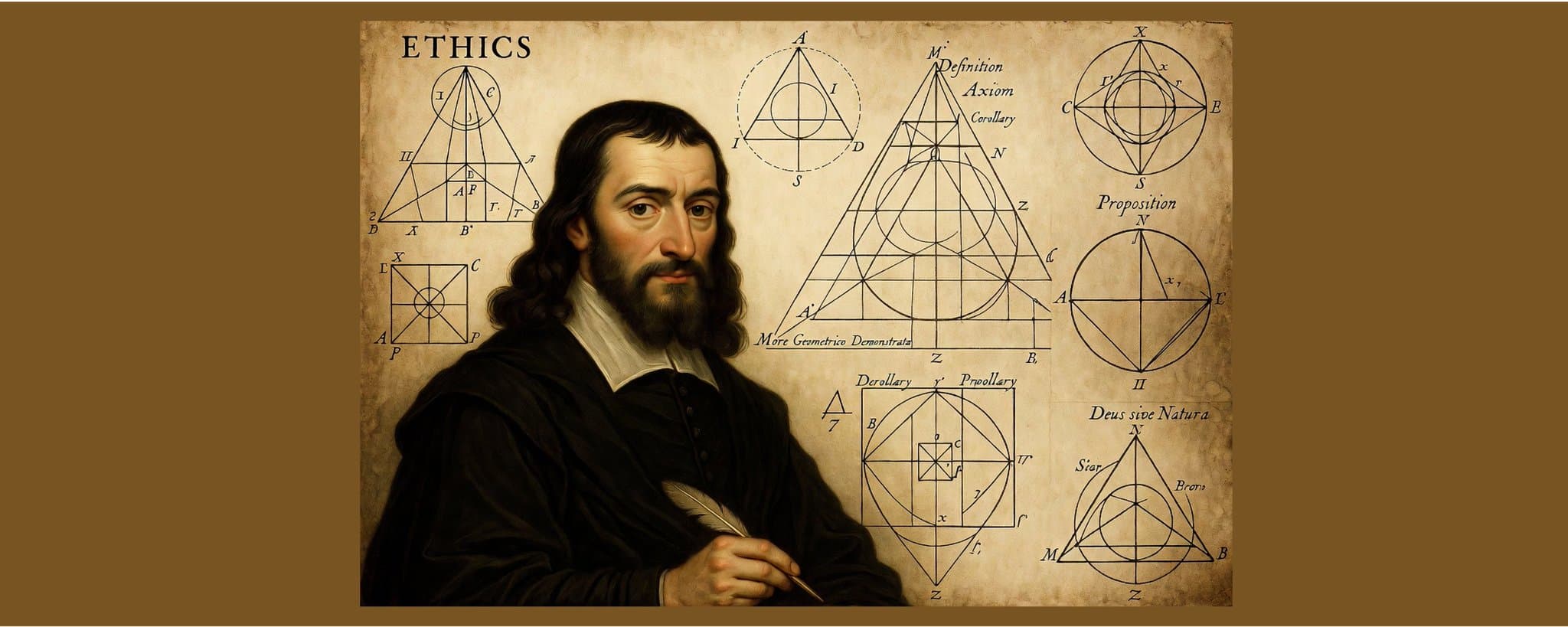
In the seventeenth century Baruch Spinoza wrote his Ethics like a book of geometry, with definitions, axioms and proofs, because he believed nature itself has that kind of structure. For him there was one infinite reality, which he called God-or-Nature, and the order we see in the world follows from within it. Nothing stands outside nature arranging it, and nothing is there to be explained by a plan.
Ffellonics asks a small version of the same question. Take identical spheres that attract on contact, let them join where they gain the most contacts, and see what builds. No blueprint is supplied. A pair becomes a triangle, then a tetrahedron, and further up the ladder the structures reach the close-packed lattices where every sphere touches twelve others.
That is a lovely picture of order that grows from the inside.
Where the two meet
The meeting point is a real one. Spinoza described God-or-Nature as an immanent cause: it produces things from within itself, not from outside. (This is from Part I of the Ethics, proposition 18, which is worth checking.) He also rejected final causes, the idea that nature works toward goals set in advance. (From the Appendix to Part I, also worth checking.)
Ffellonics fits that spirit. Each step is explained by the neighbours that are already there, and nothing pulls the structure toward a future shape. The order is built from local contact, one attachment at a time, and no designer is needed. That makes it a vivid, hold-in-your-hand illustration of the idea that order can arise from the inside.
Where they part ways
The comparison is richer if we say where the two differ, because the differences are instructive.
One substance, or many spheres? Spinoza has a single substance, and everything is a modification of it. Ffellonics begins with many separate spheres that can drift alone and come together. The spheres are many and the contacts between them are external, so this is closer to a relational atomism than to Spinoza's monism.
Necessity, or probability? Spinoza held that things could not have been otherwise (Part I, proposition 33). Real assembly involves jostling spheres that explore, detach and sometimes get stuck. In the six-sphere case, two rigid clusters can both appear, so the outcome depends on conditions, which is a different picture.
Striving, or settling? Spinoza's conatus is each thing's effort to persist in its being. Spheres do not strive. They settle toward lower free energy. The resemblance is a metaphor, though a pleasing one.
Freedom. For Spinoza, freedom is understanding the necessity that shapes us. A model of spheres has nothing to say about understanding, and Ffellonics makes no claim here.
What is honest to say
Ffellonics does not prove Spinoza right, and it cannot settle questions about monism or necessity, since a physical model cannot decide those. It is also not a theory of biological order. What it offers is an image: a simple, visible case of structure arising from within, without an outside hand, with all its limits in plain view.
An invitation
If you have ever read Spinoza and wondered what "order from within" would look like, spheres settling into a lattice is a good place to start. If you know the philosophy well, tell us where the picture helps and where it misleads. That conversation is exactly the one this comparison is meant to start.
Comments
No comments yet. Be the first to share your thoughts.