Quantum Entanglement and Ffellonics: A Relational Ontology at Two Scales
Quantum entanglement is one of the most startling features of reality: when two or more particles become entangled through interaction, their quantum states can no longer be described independently. Measuring one instantaneously determines outcomes for the other, regardless of the distance between them. This "spooky action at a distance," as Einstein called it, violates classical notions of locality and independence. It reveals that relation can be more fundamental than separation.
Ffellonics, operating in the entirely classical regime, arrives at a structurally similar conclusion by a different route. What follows is not a claim that the two phenomena are physically connected — they are not — but an examination of a genuine philosophical parallel: both challenge the picture of a universe made of isolated, independent objects, and both place relation at the centre of their ontology.
The Shared Philosophical Core
In quantum mechanics, two particles become entangled through interaction. Before that moment they can be described independently; afterward, they form a single quantum system whose properties are irreducibly joint. The interaction creates a form of non-local correlation that has no classical analogue.
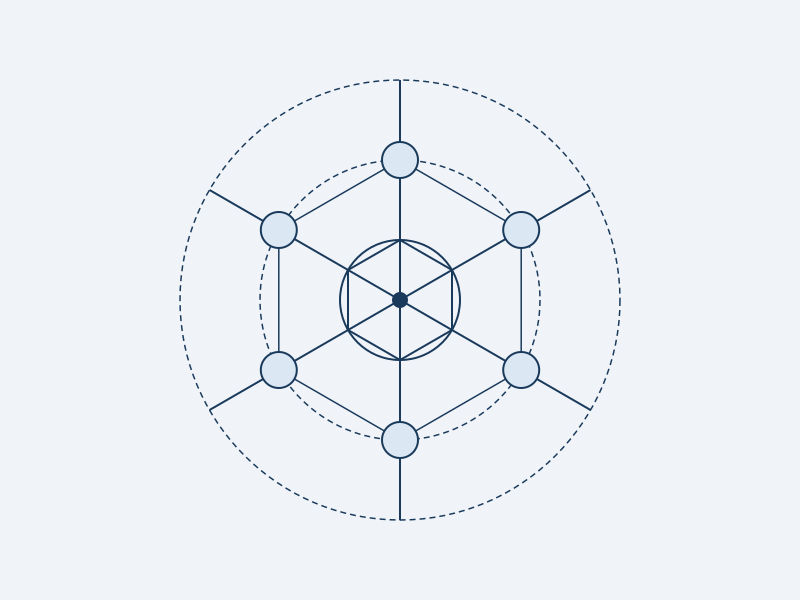
In Ffellonics, reality begins at Level 1 — the first contact between two relational units. Before contact there is only pre-relational isolation. The moment they touch, they are bound together by a single local rule: symmetric nearest-neighbor attachment under free-energy minimisation. From that first bond, a twelve-stage developmental hierarchy unfolds toward the stable 12-fold FCC/HCP lattice.
In both cases, something fundamental changes at the moment of first relation. The isolated unit is incomplete in a way the connected unit is not. This is the shared philosophical claim: relation is ontologically prior to isolation. Neither framework reaches this conclusion by importing it from the other — they arrive independently, from quantum mechanics and classical thermodynamics respectively, at the same ontological orientation.
What Connects Them and What Separates Them
The parallel is philosophical, not physical, and that distinction matters.
Quantum entanglement operates through the mathematics of Hilbert space — tensor products, unitary evolution, superposition of joint states. It is inherently probabilistic, non-local, and exists only while quantum coherence is maintained. Decoherence — the interaction of a quantum system with its environment — suppresses these quantum correlations, effectively transferring them to environmental degrees of freedom that become inaccessible. After decoherence, the system behaves classically. The quantum correlations are not transformed into classical coordination; they are suppressed. Classical nearest-neighbor bonding in a crystal is not entanglement in any quantum mechanical sense, and should not be described as such.
Ffellonics operates through classical thermodynamics and geometry — free-energy minimisation, contact maximisation, symmetry constraints. It is deterministic, local, and operates at scales where quantum effects are negligible. Sphere packing and crystal self-assembly do not emerge from decoherence; they simply operate in the classical regime where quantum considerations do not apply.
To say that the quantum correlation "matures into" classical Ffellonic coordination would misrepresent both phenomena. The honest statement is that they are parallel expressions of a relational ontology — operating at different scales, through different mechanisms, under different mathematical frameworks — that converge on the same philosophical insight: isolated objects are not the most fundamental constituents of reality.
Two Chapters of a Relational Worldview
What entanglement and Ffellonics share is not a physical mechanism but a way of reading the world.
Quantum mechanics, through entanglement, reveals that even at the most fundamental physical scale, particles that have interacted cannot be treated as genuinely independent. Their correlations are real, persistent, and irreducible to the properties of either particle alone. The universe, at its smallest scale, is already relational.
Ffellonics shows how that relational character continues to express itself at the classical scale — not through quantum correlations but through the lawful, geometric, thermodynamic progression from first contact to twelve-fold coordination. The progression is different in kind, but the underlying orientation is the same: connection is primary; isolation is the impoverished starting condition.
Together they suggest a coherent relational worldview that spans from the quantum to the classical without claiming a physical continuity between them. At the quantum level: entanglement reveals the deep interconnectedness of reality before classical definiteness sets in. At the classical level: Ffellonics shows how relational order unfolds through a clear, deterministic developmental hierarchy toward maximum coordination and minimum internal tension. These are complementary perspectives on a relational universe, not successive physical stages of a single process.
Philosophical Implications
Unity of relational ontology. Both frameworks reject the classical picture of a universe made of isolated, independent objects. This is a significant philosophical convergence, even if the physical mechanisms that support it at each scale are entirely different.
The first touch as ontological threshold. Both frameworks mark a specific moment — the interaction that creates entanglement, the first symmetric contact in Ffellonics — as the threshold between isolation and genuine relation. Before that moment: potential. After it: a new kind of reality.
Individuality reconceived. In both frameworks, the individual unit does not disappear into its relations — it is constituted by them. An entangled particle is still a particle; a sphere in the 12-fold lattice retains its position and identity. What changes is that neither can be fully described in isolation. The relational structure is part of what the individual is.
Conclusion
Quantum entanglement and Ffellonics are not competing explanations, nor are they successive physical stages of a single process. They are independent discoveries, at very different scales and through very different methods, of the same deep philosophical truth: that relation is more fundamental than isolation, and that the moment two things genuinely connect, something new enters the world that cannot be reduced to either one alone.
That convergence is worth naming. Not because it proves either framework correct, but because finding the same ontological orientation in quantum physics and classical thermodynamics suggests it may be pointing at something real about the structure of reality — something that persists across the quantum-to-classical transition even as its physical expression changes completely.
Before the first touch: only potential. After it: a relational reality with a lawful path forward. That is the insight both frameworks share, and it is enough.
Comments
No comments yet. Be the first to share your thoughts.