Same Spheres, Different Worlds: Sphere Packing in Ffellonics and in Quantum Gravity
Sphere packing turns up both in the Ffellonic Hierarchy and at the frontier of quantum gravity, but for different reasons. Seeing why is more useful than pretending they are the same.
An unexpected meeting
In 2019 three physicists, Thomas Hartman, Dalimil Mazáč and Leonardo Rastelli, published a paper with a title that sounds made for anyone who thinks about spheres: Sphere Packing and Quantum Gravity. They showed that a question about the consistency of theories of gravity is, line for line, the same calculation as a question about how tightly spheres can be packed.
For anyone who knows Ffellonics, a tempting leap follows. If gravity and sphere packing are connected, perhaps the Ffellonic Hierarchy, which is built from packed spheres, is secretly about gravity too.
This essay argues that it is not, and that the reason why is more interesting than the leap. The two ideas grow from the same root, but they sit on different branches. Keeping them apart is what lets each one say something true.
The shared root: Kepler's problem
Both stories begin with a question Johannes Kepler asked in 1611: what is the densest way to stack equal spheres? His answer was the greengrocer's pyramid of oranges, filling about 74 per cent of space. Proving it took almost four centuries. Thomas Hales and Samuel Ferguson settled it in 1998, and a computer-checked formal proof followed in 2014.
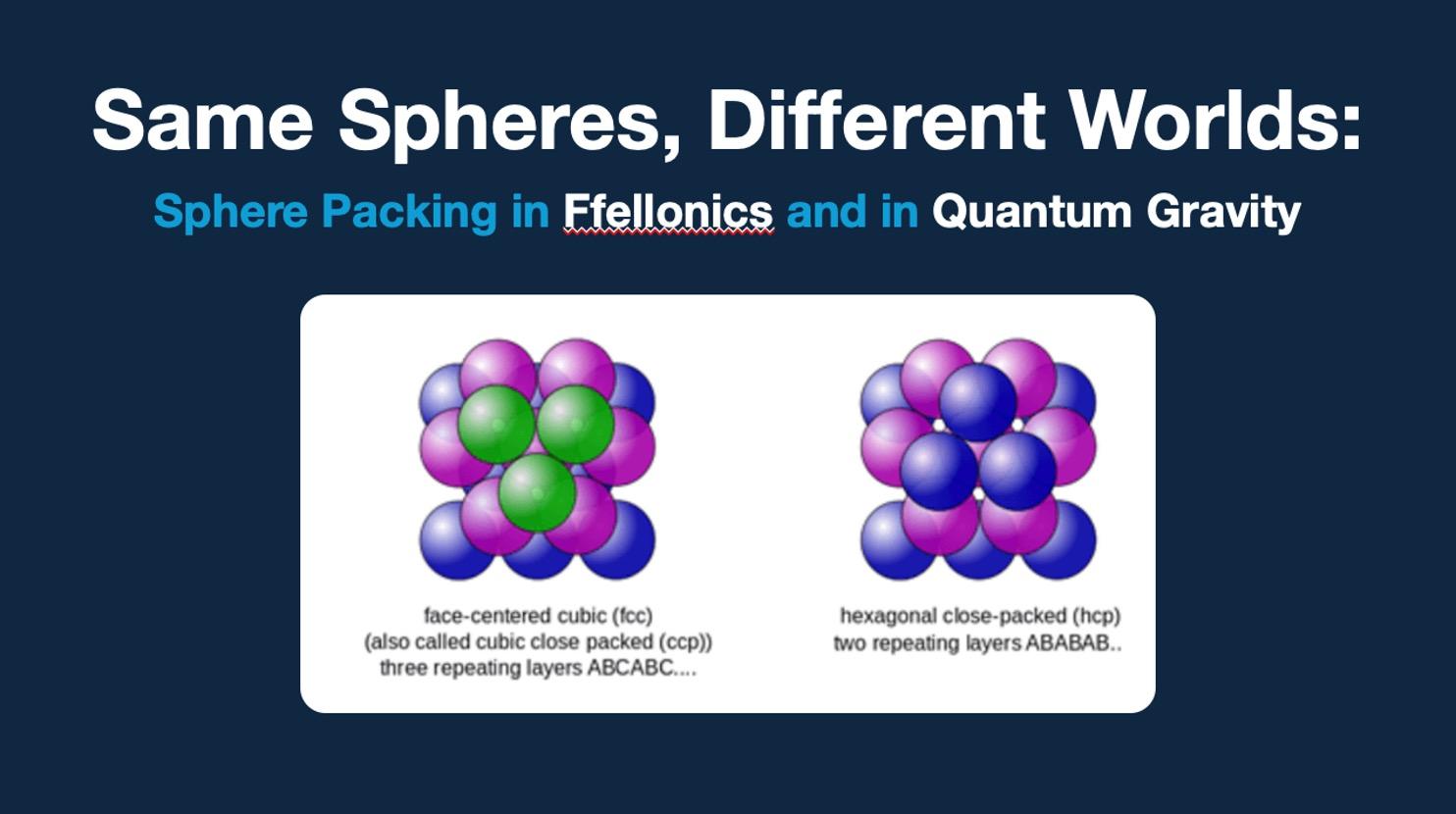
A close cousin is the kissing problem: how many equal spheres can touch one central sphere? In three dimensions the answer is 12. Two arrangements reach both limits together, the face-centred cubic and hexagonal close-packed lattices, which differ only in how their layers stack.
The same questions can be asked in any number of dimensions, and the answers change in surprising ways. In 2016 Maryna Viazovska proved that the E8 lattice is the densest packing in eight dimensions. A week later she and four colleagues proved the same for the Leech lattice in 24 dimensions. Both proofs rest on a single ingenious "magic function". Hold on to that detail: it comes back.
So sphere packing is less a single idea than a tree with many branches. Ffellonics sits on one of them. The gravity result sits on another.
Branch one: the Ffellonic Hierarchy, a physical mechanism
The Ffellonic Hierarchy is a developmental progression that moves in one direction only. It is a twelve-level progression built from a single local rule. Identical spheres, free to rearrange, attach to one another so as to make as many contacts as they can, as symmetrically as they can, while lowering their free energy. Each sphere can bond only up to its binding capacity.
A structure's level is the number of neighbours each sphere touches. Level 4 is the octahedron, where every sphere touches four others. Level 5 is the hollow icosahedron: twelve spheres, each touching five, with nothing at the centre. Level 12 is reached when every sphere touches twelve neighbours, Kepler's limit. That level is a class of lattices, not a single structure, because face-centred cubic and hexagonal close packing tie.
The rule acts under three stated conditions: how far the attraction reaches, the temperature, and each sphere's binding capacity. The conditions matter. The octahedron is favoured when the attraction is longer-range or the capacity is four bonds. The hollow icosahedron needs a capacity of five. Without its conditions, no level is guaranteed.
What makes this a mechanism rather than a pattern is that real things behave this way. Metal atoms crystallise into close-packed lattices. Microscopic colloidal beads in the laboratory assemble into small clusters and crystals. Many virus shells take icosahedral form. Ffellonics builds on a long line of work: Charles Frank on icosahedral order in liquids, Buckminster Fuller's isotropic vector matrix, and studies of "sticky" spheres by Manoharan, Brenner, Holmes-Cerfon and others. In every case the spheres are physical. They touch, they bind, and energy is released when they do.
Branch two: the modular bootstrap, a mathematical identity
The gravity result starts from holography, one of the deepest ideas in modern physics. It proposes that a universe with gravity can be described in full by a quantum theory without gravity, living on that universe's boundary. For a toy universe with two dimensions of space and one of time, the boundary theory is a two-dimensional "conformal field theory".
Those boundary theories cannot be just anything. They must stay consistent when their space is wrapped round a doughnut and the doughnut is twisted, a requirement physicists call modular invariance. The "modular bootstrap" turns that requirement into hard limits on what the theory can contain, and so on what the universe with gravity can contain.
Hartman, Mazáč and Rastelli found that, for one important family of these theories, the limit is exactly the same calculation as the best-known upper bound on sphere-packing density, due to Henry Cohn and Noam Elkies. The packing lives in a number of dimensions equal to twice the theory's "central charge", a measure of how many degrees of freedom it has. For central charges 4 and 12, their method reproduces Viazovska's magic functions for 8 and 24 dimensions. That is the detail from earlier, returning from a completely different direction.
The payoff for gravity is concrete. When the central charge is large, which corresponds to a universe where gravity is weak and classical, any consistent theory must contain a new state below roughly one eighth of the central charge. This sets a limit on where the first black holes can appear.
In this picture the "spheres" are not objects. They are points in an abstract mathematical space, often of very many dimensions. Nothing touches, nothing binds, and no energy is released. The packing is a way of counting what the theory is allowed to contain.
The distinction that matters
The two branches share mathematics but not mechanism. Set side by side, the differences are plain.
Same Spheres, Different Worlds: comparison table
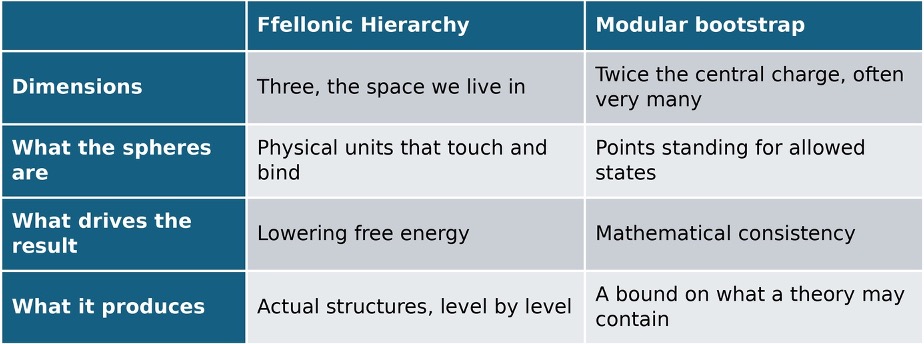
The Ffellonics series already uses this test. A mechanism-level match, such as metals crystallising or colloids clustering, shares the cause and carries real weight. A shape-only resemblance shares the look but not the cause, and is noted but not leaned on. The gravity connection belongs to neither group exactly. It is a shared ancestor: the same mathematical problem, answering different questions.
Saying so strengthens Ffellonics rather than weakening it. A framework that marks its own boundaries earns trust for the claims it does make. The Hierarchy's real case rests on physical assembly, and that case stands without help from black holes.
What would change the verdict
A verdict worth having says what would overturn it. This one can be moved in either direction.
Towards a deeper link. Someone might show that physical, three-dimensional contact packing, the kind Ffellonics describes, directly constrains a gravitational spectrum or the structure of spacetime. That would turn a shared ancestor into a shared mechanism, and it would be big news.
Away from any link. It might turn out that the bootstrap bound depends on nothing specific to packing, and that the sphere-packing form is just one convenient way of writing down a general constraint. Then even the shared-ancestor claim would weaken.
Neither has happened yet. Until one does, the honest position is the one set out here.
Coda: an open question, a quantum Hierarchy
There is a different, more speculative bridge worth naming, as long as it is labelled for what it is: a thought experiment.
In quantum computing, any network of connections can be turned into an entangled state. Each point becomes a qubit, and each link becomes an operation that entangles the two qubits it joins. These "graph states" are well understood. Apply the recipe to the Ffellonic Hierarchy, with each sphere a qubit and each contact a link, and every level becomes a quantum state of its own.
That raises questions the Hierarchy has never been asked:
Does entanglement grow from level to level the way the number of contacts does?
What would the entanglement of a Level 12 lattice look like, and would face-centred cubic and hexagonal close packing still tie?
Is there anything special about Level 5? One well-known toy model of holography, the HaPPY code of Pastawski, Yoshida, Harlow and Preskill, is built from tensors that each link to five neighbours on a tiling of pentagons. That may be no more than a coincidence of numbers, but it is a curious one.
The obvious objection must be stated plainly: touching is not entangling. Two spheres in contact are not two entangled qubits, and nothing in the classical Hierarchy says they should become so. Any quantum version would need its own reason for the translation.
If that reason can be found, the idea would join an established field. Physicists have spent more than a decade exploring the proposal that space itself is woven from entanglement, through tensor networks and holographic codes, and loop quantum gravity builds space from networks of its own. Whether the Ffellonic Hierarchy has anything to add there is an open question, offered as an invitation rather than a claim. It may grow into an essay of its own.
Sources
Hartman, Mazáč and Rastelli, Sphere Packing and Quantum Gravity, JHEP 2019
Hales et al., A Formal Proof of the Kepler Conjecture, Forum of Mathematics, Pi, 2017
de Laat and Vallentin, A Breakthrough in Sphere Packing: The Search for Magic Functions, 2016 (on Viazovska's 8- and 24-dimensional proofs)
Pastawski, Yoshida, Harlow and Preskill, Holographic Quantum Error-Correcting Codes, JHEP 2015
Comments
No comments yet. Be the first to share your thoughts.