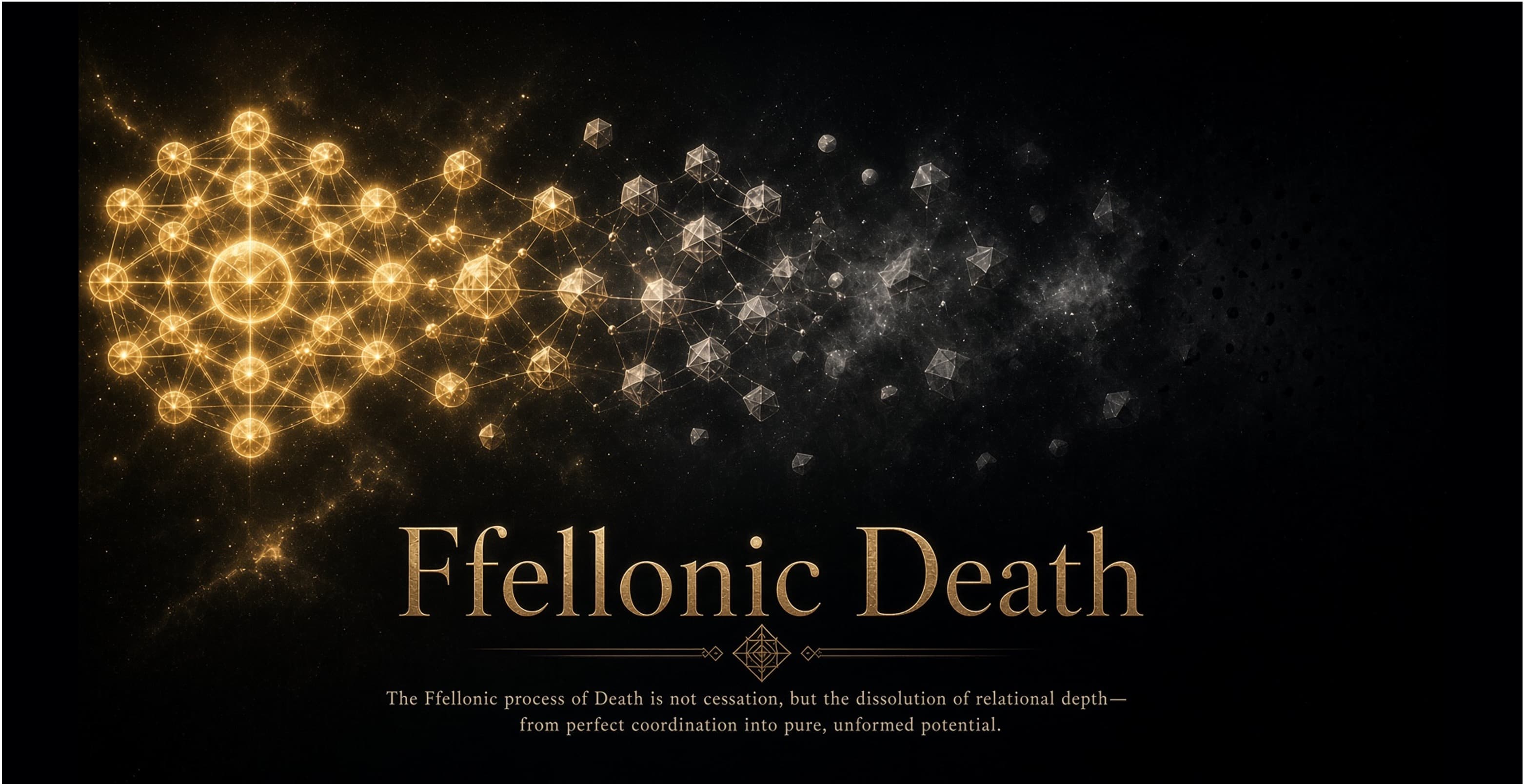
Speculative Extension: A Forward Degradation Hierarchy in Ffellonic Terms
Ffellonics itself contains only a constructive hierarchy. What follows is a speculative extension that applies its core principles—local relational rules, free-energy dynamics, geometric levels of coordination, and consciousness as felt relational depth — to a separate, forward-moving process of degradation.
The original Ffellonic rule drives units toward greater coordination: symmetric attachment maximises contacts and minimises free energy, generating a twelve-level ascent that culminates in the Level-12 lattice of maximum integration and minimum tension. Consciousness tracks this ascent as progressive relational depth.
Under sustained free-energy failure the same thermodynamic logic can be imagined to support a parallel but opposite trajectory. Instead of attachment, the dominant local tendency becomes detachment and loss of coordination. Each successive layer of this degradative hierarchy represents a further irreversible reduction in relational structure: higher-order integration collapses first, followed by the progressive dismantling of intermediate coordination shells, the dissipation of gradients, and the breakdown of molecular order. Free energy is no longer minimised into stable attachments; it is exhausted and dispersed as heat and rising entropy.
The process remains strictly forward. It does not reverse the constructive hierarchy; it constitutes an independent sequence whose own ground state is the complete absence of organised relation—the fully equilibrated condition in which units exist once more as isolated potential. In biological terms this terminal ground state corresponds to death.
Consciousness, being the internal aspect of relational depth, would diminish in step with the descending layers: complex integrative awareness is lost early, simpler forms of responsiveness later, until the ground state leaves no structured field of experience at all.
This extension preserves Ffellonic minimalism—one local thermodynamic tendency, discrete levels of coordination, geometric language—while locating degradation on its own forward path. It remains an interpretive overlay, not a claim of the original framework. Its usefulness lies in showing how the same relational and energetic principles that generate order can, under opposite boundary conditions, coherently describe the progressive loss of order and awareness.
Comments
No comments yet. Be the first to share your thoughts.