The Closed Hierarchy
In 1694, Isaac Newton and David Gregory disagreed about a question that sounds like a parlour puzzle. How many identical balls can touch a central ball of the same size? Newton said twelve. Gregory thought a thirteenth might squeeze in. The dispute stayed open for more than two and a half centuries, until Kurt Schütte and Bartel van der Waerden proved Newton right in 1953. Twelve is the kissing number of three-dimensional space. No arrangement, however clever, fits a thirteenth sphere.
Set theory has no such number. Its standard picture of the mathematical universe is a hierarchy of collections built in stages, and the stages never run out. After every finite stage comes stage ω, then ω+1, and so on through an endless sequence of ordinals. There is no final stage, and there cannot be one.
This essay is about what happens when those two facts meet. Ffellonics describes a hierarchy of twelve levels, from a single dyad of touching spheres to the fully packed arrangement in which every sphere touches twelve others. I will argue that this hierarchy has the same structure as set theory's cumulative hierarchy, with one decisive difference.
Ffellonics is the iterative conception of set made physical, and space is what makes it finite.
Why the comparison is worth making
Every mathematical structure can be built from sets, so saying that a piece of geometry "relates to set theory" is usually empty. The comparison here is narrower. Set theory has a particular account of how collections come to exist, and that account has a definite shape. If a geometric hierarchy shares the shape, the two can be compared point by point, and the place where they differ tells us something.
The account comes from Ernst Zermelo, who showed in 1930 that models of set theory can be arranged as layered domains, each containing the last. George Boolos gave it its philosophical form in 1971 and called it the iterative conception of set. At the first stage there is nothing, or only raw individuals. At each later stage, every collection of things already available is formed. Two features matter. The stages are cumulative, so whatever exists at one stage exists at every later stage. And they are ordered: a set is formed after its members, never before. Once a set is formed it is never unformed.
Accumulation
Ffellonic levels are cumulative in the same sense. Level k keeps everything achieved at the levels beneath it. The dyad of level 1 persists inside every later level, and so does every contact and every symmetry established along the way. In set-theoretic notation, the stages satisfy Vα ⊆ Vβ whenever α comes before β. The Ffellonic levels satisfy the same relation.
John von Neumann's construction of the natural numbers makes the parallel more literal still. In his scheme each number is the collection of all the numbers before it, so 3 is the set {0, 1, 2}. A Ffellonic level is, in this sense, the gathered record of its predecessors plus one new step.
Direction
In the iterative conception, the order of stages is part of why sets are what they are. A set cannot come before its members. Ffellonics is directional in the same way. Levels are reached by progression, and the progression belongs to what each level is. A level-6 configuration is more than a cluster in which a sphere has six contacts. It is a cluster that has passed through levels 1 to 5 to get there.
Level 0 fits the picture well. Spheres without relation are like the ground of the set-theoretic hierarchy: things that can be collected, with no structure yet. In Zermelo's version with individuals, the hierarchy begins with exactly such a collection of unrelated elements. Everything after level 0 is structure being added, one contact at a time.
The ceiling
Here the parallel breaks, and the break is the point. The set-theoretic hierarchy is unbounded because nothing limits how many things a collection may gather. Cantor's theorem guarantees that the collections formed from any stage always outnumber the stage itself, so there is always somewhere new to go.
Spheres in space are not so free. Each Ffellonic level adds coordination, and coordination costs room on a sphere's surface. That room is finite. At twelve contacts it is spent. The face-centred cubic and hexagonal close-packed arrangements realise this final level, and Thomas Hales's proof of the Kepler conjecture confirms that nothing packs identical spheres more densely. They fill π/√18 of space, about 74 percent.
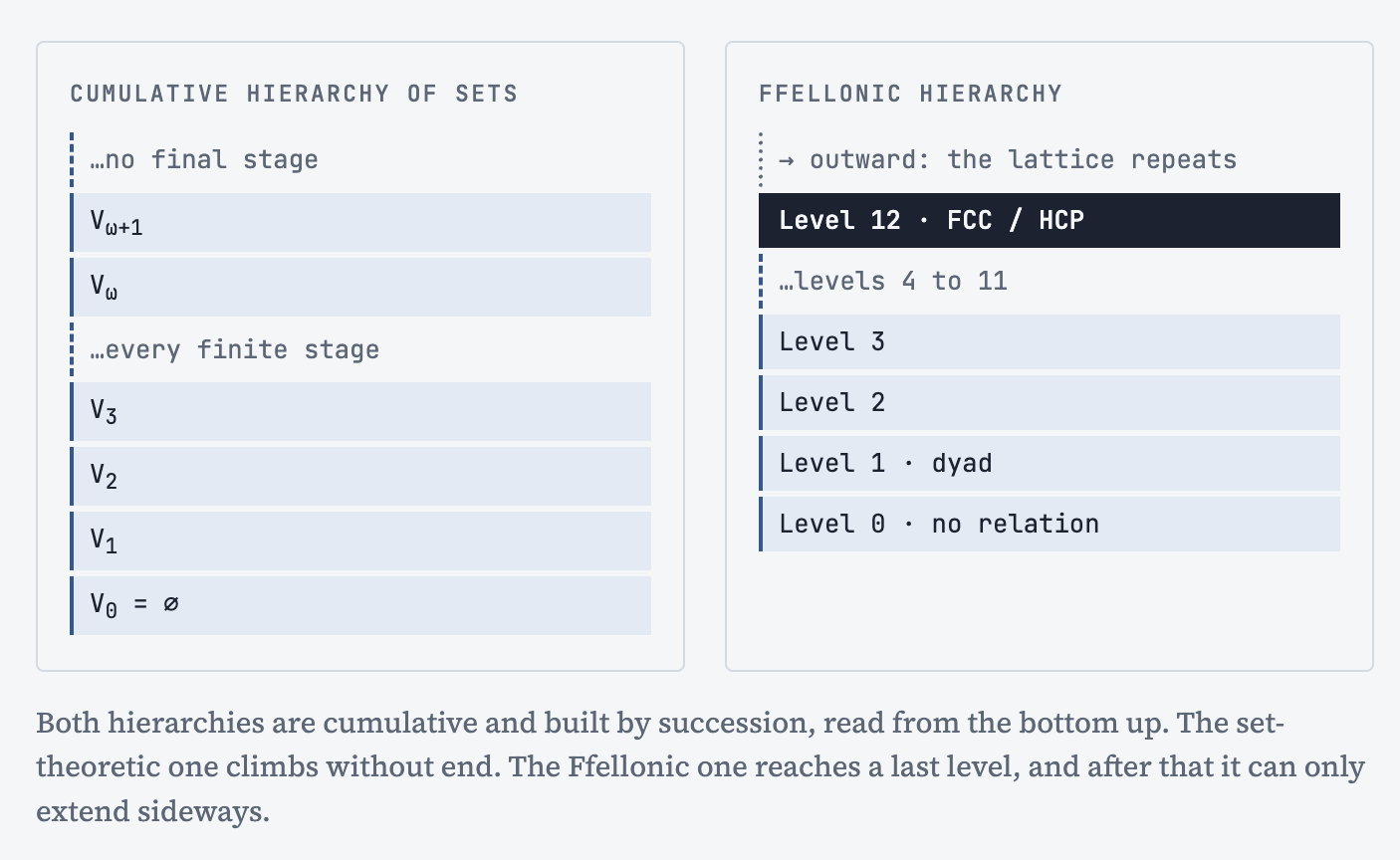
So the Ffellonic hierarchy has something the cumulative hierarchy never has: a last level. Growth continues after twelve, but only outward, by repeating the completed pattern across the lattice. That lattice is infinite, and countably so, but its infinity is one of extension. It adds more of the same, never a new kind. Set theory climbs forever. Ffellonics climbs to twelve and then spreads.
The objection from subtraction
A mathematician will object that geometric configurations can be taken apart. Remove a sphere from a level-12 cluster and you get a smaller cluster. On this view the levels are just objects, and "accumulation" is a story told about them.
The first part is true, and it holds for sets as well. You can take a subset of any stage of the cumulative hierarchy. That does not mean the stage was built by removal, and it does not undo the order in which the stage came to be. The hierarchy describes how things come into being, not every operation that can later be performed on them. Ffellonics is a progressive study in the same sense. Removing a sphere produces a cluster; it does not reverse the history that produced the level. A person can say afterwards that they did not mean to do something, but the experience still happened, and what was gained from it remains.
One limit should be stated plainly. The parallel is structural. Spheres are not sets, and contact is not membership. The claim is that the two hierarchies share a pattern: cumulative, ordered, generated by succession from a structureless ground. It is not a claim that either reduces to the other.
What follows
Philosophers have long asked whether the endless hierarchy of sets describes anything real, or only what logic permits. Ffellonics suggests the question divides in two. The pattern of accumulation may be general, found wherever collections are built from what came before. The extent of accumulation depends on the space it happens in. In the abstract, nothing stops the climb. In three dimensions, it stops at twelve.
That dependence on space can be tested. The kissing number changes with dimension: it is 24 in four dimensions, 240 in eight and 196,560 in twenty-four. A Ffellonic hierarchy built in those spaces would have its own final level, set by the geometry of its dimension. The ceiling is not an accident of our world's arithmetic. It is a property of the space doing the collecting.
Set theory tells us how to accumulate without end. Ffellonics shows what accumulation looks like once it has somewhere to live.
References
G. Boolos, "The Iterative Conception of Set," The Journal of Philosophy 68 (1971).
E. Zermelo, "Über Grenzzahlen und Mengenbereiche," Fundamenta Mathematicae 16 (1930).
J. von Neumann, "Zur Einführung der transfiniten Zahlen," Acta Sci. Math. (Szeged) 1 (1923).
K. Schütte and B. L. van der Waerden, "Das Problem der dreizehn Kugeln," Mathematische Annalen 125 (1953).
T. C. Hales, "A proof of the Kepler conjecture," Annals of Mathematics 162 (2005).
O. R. Musin, "The kissing number in four dimensions," Annals of Mathematics 168 (2008).
Comments
No comments yet. Be the first to share your thoughts.