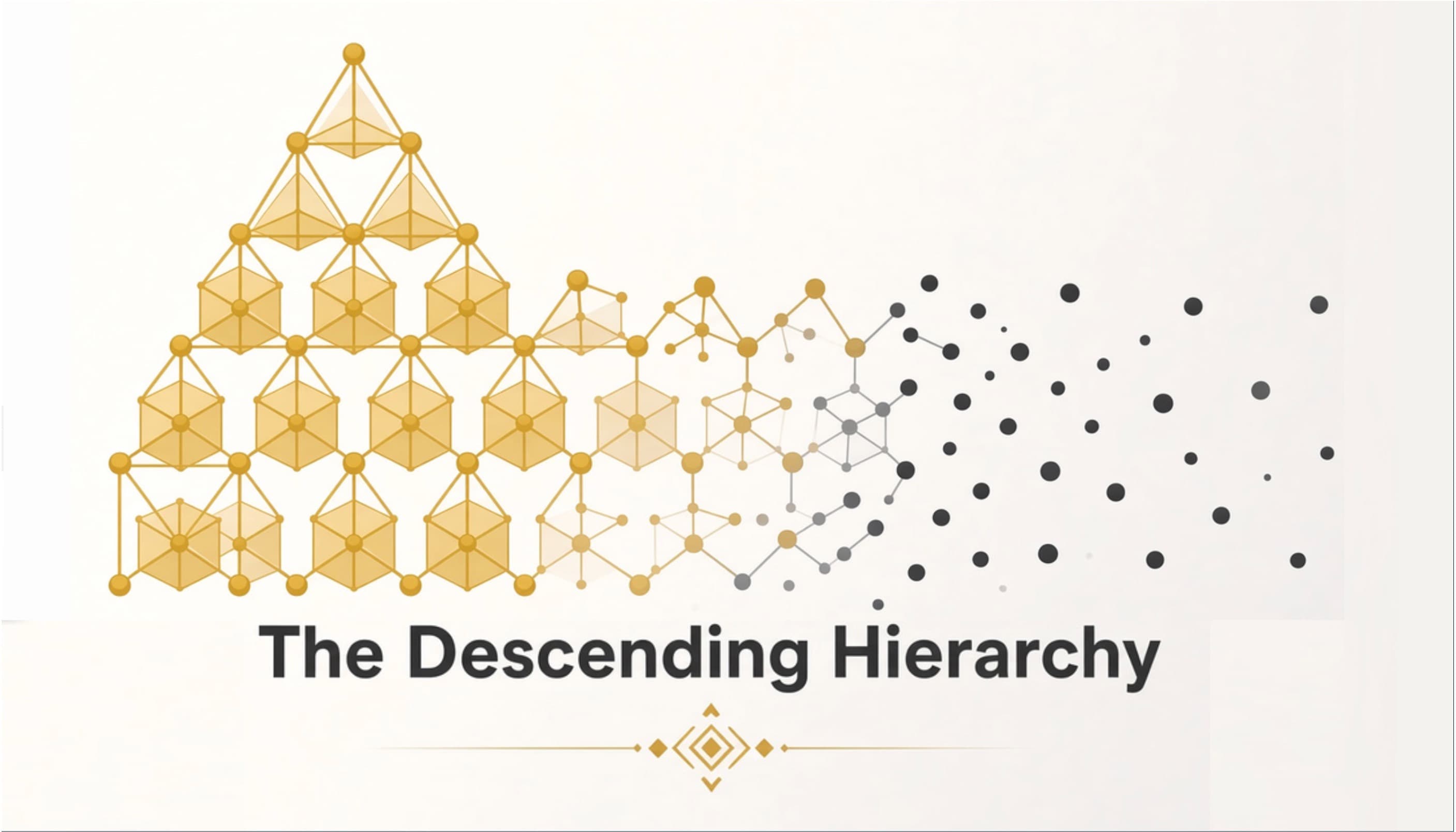
The Descending Hierarchy: A Ffellonic Reading of Decline and Death
Ffellonics itself contains only a constructive hierarchy. What follows applies its core principles — local relational rules, free-energy dynamics, geometric levels of coordination, and consciousness as felt relational depth — to a separate, forward-moving process of degradation. This is a speculative extension, not a claim of the original framework. Its value lies in showing that the same thermodynamic logic that generates order can, under opposite boundary conditions, describe with equal coherence the progressive loss of order and awareness.
The Constructive Direction
The original Ffellonic rule drives identical units toward greater coordination. Symmetric attachment maximises contacts and minimises free energy, generating a twelve-level ascent that culminates in the lattice of maximum integration and minimum internal tension. Consciousness, understood as the felt internal aspect of relational depth, tracks this ascent: each level represents not only a more coordinated geometric configuration but a richer field of experience, a deeper participation in the relational whole.
This is the story of becoming — of isolated potential finding, through one local rule applied again and again, its way toward the most fully realised configuration that three-dimensional space allows.
The Opposite Boundary Condition
Under sustained free-energy failure, the same thermodynamic logic supports a parallel but opposite trajectory. When a system can no longer draw the free energy needed to maintain its relational structure, the dominant local tendency shifts from attachment to detachment — from coordination to its loss. The constructive hierarchy does not reverse; instead, under these changed conditions, relational structure begins to dissolve according to the same thermodynamic logic operating in the only other direction available to it.
Each successive layer of this degradative hierarchy represents a further irreversible reduction in relational structure. Higher-order integration collapses first — the most complex and energy-expensive coordinations are the first to fail. Intermediate coordination shells follow. Gradients dissipate. Molecular order breaks down. Free energy is no longer minimised into stable attachments; it is exhausted and dispersed as heat and rising entropy.
This process is strictly forward. It constitutes an independent natural sequence driven by the same thermodynamic imperative under opposite conditions. Its own ground state is the complete absence of organised relation: the fully equilibrated condition in which units exist once more as isolated potential.
In biological systems, that terminal ground state corresponds to death.
The Diminishment of Consciousness
Consciousness, being the internal aspect of relational depth, diminishes in step with the descending layers. This follows directly from what the framework has already established. If relational depth is what consciousness is, then the loss of relational depth is the loss of consciousness, stage by stage, in the same order that coordination is lost.
Complex integrative awareness fails first, because it depends on the highest-level coordinations, which are the first to go when free energy can no longer sustain them. Simpler forms of responsiveness persist longer, supported by lower level coordinations that are more robust and less energetically demanding. Those too diminish until the terminal ground state is reached.
At that point the structured field of experience is gone. There is no continuing personal consciousness, no residual awareness persisting independently of the relational structure that supported it. The framework does not say this to be bleak. It says it because this is what the logic of relational depth, followed honestly to its conclusion, actually entails. A framework that builds consciousness out of relational coordination cannot, without contradiction, claim that consciousness survives the complete dissolution of relational coordination.
What Remains
What remains after the terminal ground state are external traces — and the framework is precise about what these are and what they are not.
They are not continuations of the individual’s own consciousness. They are not a residual personal field of experience. The framework makes no room for that.
What they are is something a relational ontology makes genuinely meaningful. The memories held in the relational networks of other living systems are real relational structures — coordinations that exist within the constructive hierarchies of others who are still building. The effects of a life’s actions and accomplishments persist in the world as genuine modifications of relational structure — changes to the configurations of other hierarchies that continue to shape what those hierarchies become.
Within a relational ontology this is not nothing. A life that has deepened the coordination of other systems has left real relational traces. Those traces are not the person who left them. But they are part of the relational fabric of the world, persisting in the ongoing becoming of other constructive hierarchies long after their own has reached its terminal ground state.
This is what a relational account of legacy means: not that something of us survives, but that what we built in others does.
The Complete Arc
Every constructive account describes the upward direction — how relation builds, how order emerges, how coordination deepens toward the twelve-fold ground state. This chapter establishes that the framework is not one-sided. It has a full arc.
Birth is the first contact — the moment two units touch and the local rule begins to operate. Development is the climb through successive levels of coordination. Maturation is the approach to maximum integration and minimum tension. Then, under the changed boundary conditions of sustained free-energy failure, the descending hierarchy begins — the same thermodynamic logic running toward the only other ground state available.
From the first touch the hierarchy builds. When the free energy that sustained the building finally fails, the hierarchy dissolves. What remains — in the relational networks of others and in the effects of what was built — is not the person, but the genuine mark of what that person’s relational life added to the world.
Conclusion
The descending hierarchy completes the Ffellonic picture of existence: consciousness deepens as relational coordination builds, and diminishes as that coordination fails, until the terminal ground state leaves no structured field of experience at all. What persists is not the individual, but the relational traces left in the constructive hierarchies of others.
This remains a speculative extension, not a claim of the original framework. Yet the same thermodynamic logic that generates order describes, under opposite conditions, its loss — and in doing so gives the full arc of a life a coherent, honest, and complete geometric language.
Comments
No comments yet. Be the first to share your thoughts.