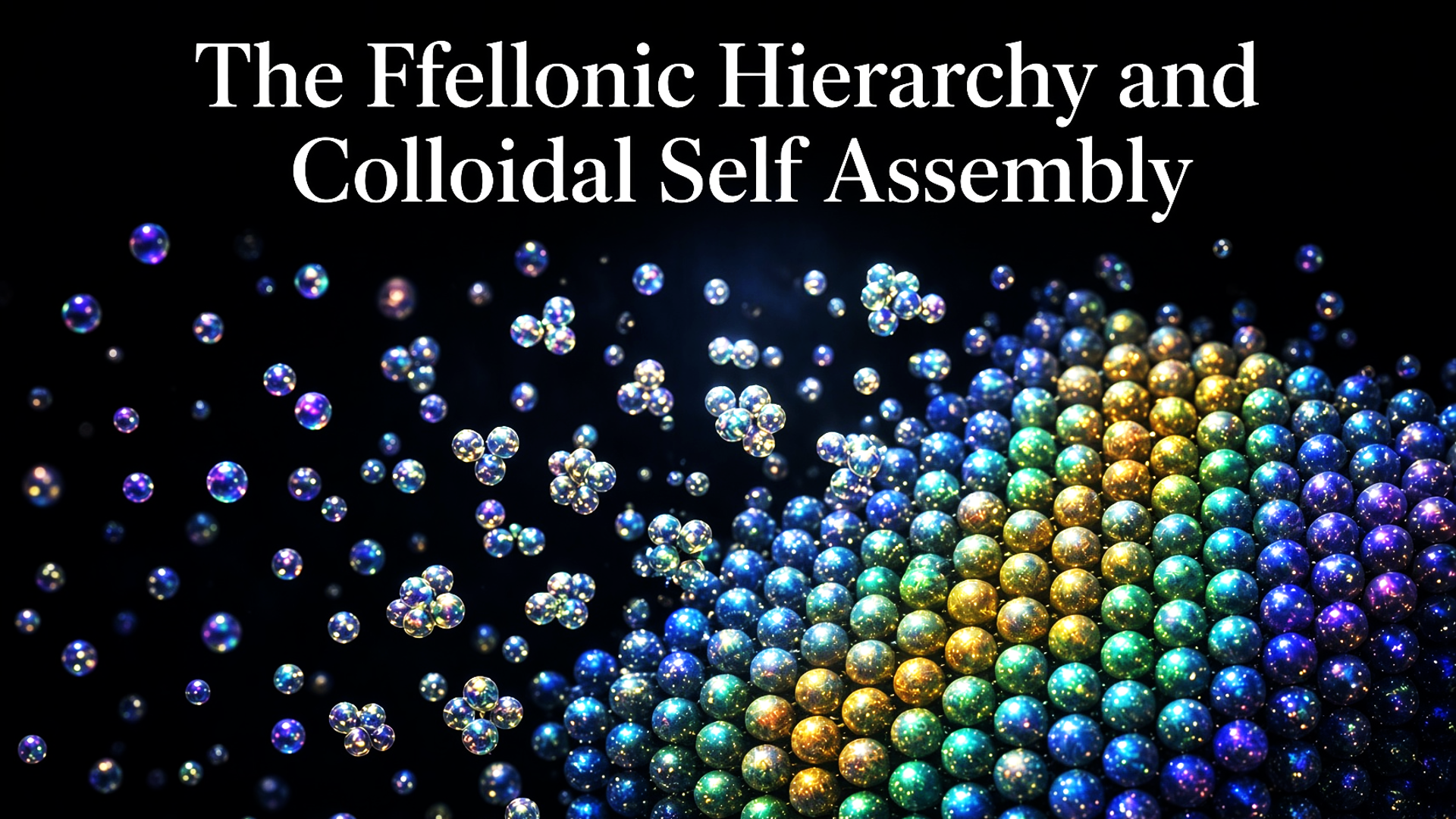
The Ffellonic Hierarchy and Colloidal Self-Assembly
Ffellonics is a hierarchical model of three-dimensional order that arises from a single, local generative rule applied to identical spheres. Developed as a geometric framework by David Eric Ffell, it posits that symmetry and dense packing emerge bottom-up when each new sphere attaches in the position that maximizes nearest-neighbor contacts while preserving local symmetry and structural integrity. This process produces a discrete 12-level progression indexed primarily by coordination number (the average number of contacts per sphere). The sequence begins with the minimal relational unit and culminates in the densest regular packings allowed in Euclidean three-space.
The 12-Level Hierarchy
The hierarchy unfolds as follows in its idealized form:
Level 1: Dyad — two spheres in contact (coordination number k = 1 ).
Level 2: Equilateral triangle.
Level 3: Tetrahedron — the first closed volumetric form and the simplest Platonic solid (k \approx 3 ).
Level 4: Octahedron.
Level 5: Icosahedron — a highly symmetric finite cluster often associated with five-fold local order.
Intermediate levels continue to build successive symmetric shells and polyhedral arrangements.
Level 12: The face-centered cubic (FCC) or hexagonal close-packed (HCP) lattice (or the related tetrahedral-octahedral honeycomb), in which every sphere has exactly twelve equidistant neighbors — the maximum (kissing number) achievable for equal spheres in 3D and the densest regular packing..
Early levels produce finite, highly symmetric clusters (including the classical Platonic solids as transient milestones). Later levels transition into extended, periodic lattices. Within the model the process is thermodynamically directed: each attachment that increases contacts reduces excluded volume and lowers free energy. Finite clusters occupy metastable basins; continued particle addition and mild agitation allow the system to escape these basins and relax toward the global free-energy minimum at Level 12.The framework emphasises that the Platonic solids are not pre-imposed ideal forms but natural, temporary intermediates that appear when spheres seek maximal local symmetry. The endpoint is a configuration of maximum coordination and minimal internal tension in which individual spheres retain their integrity while participating in complete interdependence.
Alignment with Colloidal Self-Assembly
Although the precise 12-level discretization is a geometric idealization, extensive experimental and computational work on colloidal systems reveals closely analogous hierarchical pathways. When near-identical particles interact through short-range attractions or hard-sphere repulsion and are free to minimize free energy via local contacts, they frequently pass through small symmetric clusters before forming extended close-packed crystals.
Classic confocal microscopy studies of hard-sphere colloids (Gasser et al., 2001) showed that nucleation begins with dense, liquid-like aggregates that often exhibit tetrahedral and icosahedral local order. The surrounding supercooled fluid is enriched in five-fold and icosahedral motifs, which increase with volume fraction near the glass transition. Critical nuclei themselves ultimately adopt random hexagonal close-packed character, but the pathway includes the finite-cluster intermediates predicted by the early Ffellonic levels.
Spherical confinement produces especially clear evidence of icosahedral order. Entropy alone, under confining boundaries such as emulsion droplets, drives the spontaneous formation of large icosahedral clusters containing thousands to tens of thousands of particles (de Nijs et al., 2015). These “magic-number” clusters, related to Mackay icosahedra, are thermodynamically favored over bulk FCC packing for finite sizes. Subsequent growth or coalescence leads to rearrangement into hexagonal layers characteristic of FCC/HCP lattices.
Hierarchical assembly is further demonstrated with designer patchy particles. Triblock patchy colloids first form discrete, self-limiting tetrahedral clusters; these secondary building blocks then pack into ordered tetrastack or related crystalline structures (Rao, Shaw, Neophytou, Chakrabarti et al., 2020). The staged pathway suppresses defective rings that hinder crystallization and mirrors the Ffellonic progression from finite symmetric intermediates to extended lattices. Analogous routes have been realized for octahedral and other polyhedral clusters.
Granular and vibrational-annealing experiments supply a complementary macroscopic picture. Random close packing of spheres (packing fraction ≈ 0.64) contains a broad distribution of local coordinations (Bernal & Mason, 1960). Prolonged gentle agitation allows the system to escape metastable disordered states and anneal into crystalline close packing near 0.74. Theoretical analyses of jammed packings (Torquato and collaborators) formalize the distinction between maximally random jammed states and ordered FCC/HCP crystals, reinforcing the idea of a free-energy landscape with intermediate basins that can be traversed under appropriate conditions.
Recent work continues to document related phenomena: polyhedral colloidal clusters (including tetrahedral and icosahedral forms) assembled in deformable droplets, entropy-driven five-fold and icosahedral twinning in hard particle systems, and multi-shell icosahedral aggregates whose packing fractions and defect structures can be quantified in three dimensions by advanced microscopy.
Implications
The correspondence between the Ffellonic hierarchy and colloidal observations suggests that a simple contact-maximizing rule, combined with free-energy minimization, is sufficient to generate staged order in three-dimensional Euclidean space. In laboratory systems the pathway is rarely as clean or discrete as the ideal 12-level model — polydispersity, kinetics, and additional interactions introduce variability — yet the recurring appearance of tetrahedral, octahedral, and especially icosahedral clusters as precursors to close-packed lattices provides empirical grounding for the geometric sequence.
Ffellonic geometry therefore functions as a minimal reference model: one local rule, a finite hierarchical depth, and a well-defined ground state. It offers a conceptual benchmark against which real self-assembly processes (colloidal crystallization, nanoparticle superlattices, viral capsids, and certain granular packings) can be compared. Where experimental pathways are compressed, interrupted, or enriched by additional forces, the ideal hierarchy still illuminates the underlying thermodynamic drive toward maximal symmetric coordination.
In summary, the Ffellonic hierarchy abstracts a generative principle of relational self-assembly that nature repeatedly realizes, in approximate and often truncated form, whenever identical or near-identical particles are free to maximize contacts in three dimensions. Colloidal research supplies the most direct laboratory window onto this process, confirming that finite Platonic-like clusters are genuine, observable waypoints on the path from disordered contacts to dense, ordered lattices.
Selected References
• Bernal, J. D. & Mason, J. Packing of spheres: Co-ordination of randomly packed spheres. Nature 188, 910–911 (1960).
• Gasser, U. et al. Real-space imaging of nucleation and growth in colloidal crystallization. Science 292, 258–262 (2001).
• de Nijs, B. et al. Entropy-driven formation of large icosahedral colloidal clusters by spherical confinement. Nature Materials 14, 56–60 (2015).
• Rao, A. B. et al. Leveraging hierarchical self-assembly pathways for realizing colloidal photonic crystals. ACS Nano 14, 5348–5359 (2020).
• Torquato, S. & Stillinger, F. H. Jammed hard-particle packings: From Kepler to Bernal and beyond. Reviews of Modern Physics 82, 2633–2672 (2010).
• Additional literature on magic-number clusters, Mackay icosahedra, patchy-particle hierarchical assembly, and confined colloidal crystallization (2015–2026).
Comments
No comments yet. Be the first to share your thoughts.