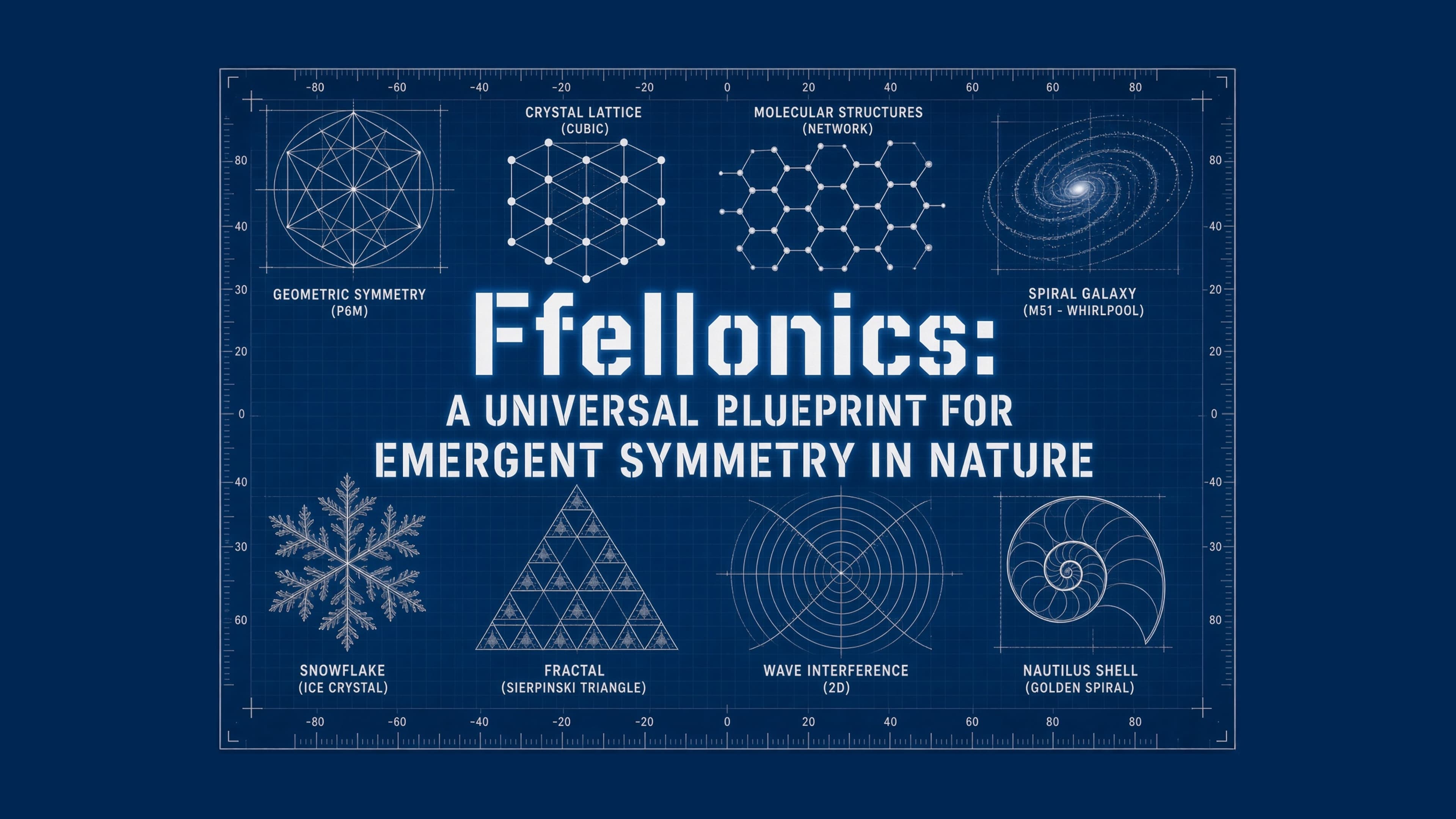
The Genericity of Ffellonic Geometry: A Universal Blueprint for Emergent Symmetry in Nature
Ffellonic geometry, introduced by David Fell as a sphere-centric framework for three-dimensional symmetry, stands out for its genericity. At its core lies a single generative rule: identical spheres attach, maximizing contacts while preserving symmetry. This rule unfolds into a 12-level hierarchy, from a minimal dyad (Level 1, coordination k=1) to a maximally coordinated lattice (Level 12, k=12) — face-centered cubic (FCC) and hexagonal close-packed (HCP) arrangements, which are tied for maximum density among regular sphere packings, both realizing this terminal coordination.
What would make Ffellonic geometry generic, in the sense worth taking seriously, isn't specificity to one domain but recurrence across several: the same broad pattern of local, symmetric, energy-minimizing self-organization shows up in physics, biology, and beyond. That claim is worth examining domain by domain, distinguishing cases where the underlying mechanism actually matches Ffellonics' attractive-bonding rule from cases that merely resemble it in outcome.
Genericity in Physics: Where the Mechanism Matches, and Where It Doesn't
Sphere-packing hierarchies are central to understanding dense matter, and it's worth being precise about which physical examples actually share Ffellonics' mechanism and which only share its final geometry.
Where the mechanism matches: Ffellonics' rule is explicitly attractive — spheres bond, releasing energy and exporting entropy as stronger contacts form, settling toward a Gibbs free-energy minimum. This is the real, correctly-described basis of processes like colloidal or atomic crystallization when attractive forces between particles drive the ordering — for instance, many metals (gold, copper, aluminium, nickel) adopting FCC packing as their equilibrium lattice, reflecting Level 12's terminal coordination through genuine bond formation.
Where the geometry matches but the mechanism doesn't: It's worth flagging a well-known, closely related but mechanistically distinct phenomenon, precisely because it's easy to conflate with the first case. Hard-sphere systems — particles with no attraction at all, purely repulsive, unable to overlap — also crystallize at high density, in the famous Kirkwood-Alder transition. But they do so for the opposite reason: an ordered lattice gives each sphere more accessible free volume than a jammed, disordered packing, so crystallization there is driven by entropy maximization, not energy minimization, and involves no bonding or energy release at all. Both routes can terminate in the same FCC/HCP geometry, which is exactly why they're worth distinguishing rather than treating as one phenomenon: Ffellonics' generative claim is specifically about the energy-minimizing, bond-forming route, and citing the entropy-driven route as confirmation would be citing the right destination reached by a genuinely different road.
Beyond three dimensions, sphere-packing problems become a distinct, highly technical branch of mathematics — most notably Maryna Viazovska's 2016 proof of the optimal packing in 8 dimensions (the E8 lattice), with a follow-up proof for 24 dimensions (the Leech lattice) the same year with collaborators. These are major, specific results, solving one exceptionally hard problem in two dimensions with unusual algebraic structure (via modular forms) — not a general demonstration that "Ffellonic-like hierarchies" solve packing problems broadly. They're worth citing as evidence that sphere packing is a serious, active mathematical field with real open problems still being resolved, not as direct support for Ffellonics' specific 12-level hierarchy, which is a different kind of object (a generative, level-by-level narrative in 3D) than what Viazovska's proofs address.
Genericity in Biology: The Strongest Domain for This Claim
Biology offers the most mechanistically direct parallels. Viral capsids frequently adopt icosahedral symmetry (Level 5), where a small number of identical protein subunits, symmetrically arranged, build a stable shell more cheaply — in both genetic and energetic terms — than an asymmetric shell would require. This is a well-established, mechanistically close match to Ffellonics' own logic: identical units, local interaction, energy minimization, symmetric result.
Michael Levin's work on natural induction and on self-organizing biological structures — including biobots, where dissociated cells reassemble into structured, sometimes symmetric forms without a conventional genetic developmental program — is a genuine, relevant parallel to Ffellonics' bottom-up emergence, and one already examined in more depth elsewhere in this series regarding exactly how far that parallel extends. Tree branching and fractal-like growth patterns are a looser case: they do optimize resource distribution efficiently, but through diffusion-limited growth and structural mechanics rather than anything resembling discrete sphere attachment, so the connection here is one of shared efficiency-seeking logic rather than shared mechanism.
Genericity in Cosmology: A Shared Shape, Not a Shared Mechanism
The cosmic web — galaxies clustering into filaments and dense nodes around sparser voids — is often described in the hierarchical, clustering vocabulary this essay uses for Ffellonics. But the underlying physics is gravitational instability acting on primordial density perturbations over cosmic time, a completely different mechanism from local, symmetric, contact-maximizing attachment between identical units. This is worth stating plainly rather than glossed over: the resemblance is one of vocabulary and rough visual shape (density gradients, hierarchical clustering) rather than shared generative mechanism, and it shouldn't be presented with the same confidence as the viral-capsid case, which does share Ffellonics' actual logic.
Planetary regolith and rubble-pile asteroids are a genuinely closer physical case, since they really are granular sphere-like packings governed by contact mechanics and gravity — worth keeping as a real example of variable-density packing physics, distinct from the cosmic web comparison, which operates at an entirely different scale and via an entirely different force.
Conclusion: What "Generic" Can Honestly Mean Here
Ffellonic geometry's single generative rule does recur, in a mechanistically direct sense, in a specific and identifiable set of physical and biological systems: energy-driven crystallization in real attractive systems, viral capsid assembly, and aspects of Levin's work on emergent biological structure. It recurs in a looser, shape-resembling sense in several other domains — hard-sphere entropic crystallization, high-dimensional lattice packing, cosmic-scale clustering — where the geometry rhymes but the underlying physics doesn't match. Both kinds of recurrence are worth naming, but they support different strengths of claim, and the more valuable version of "genericity" here is the honest one: a small number of systems where Ffellonics' actual mechanism is doing real explanatory work, surrounded by a wider set of systems where its geometry offers a useful point of comparison without claiming to explain the underlying physics. Future work extending the framework to curved spaces or exploring which of these connections can be made mechanistically precise, rather than descriptively resonant, would do more to establish genuine generality than expanding the list of domains it's compared to.
Comments
No comments yet. Be the first to share your thoughts.