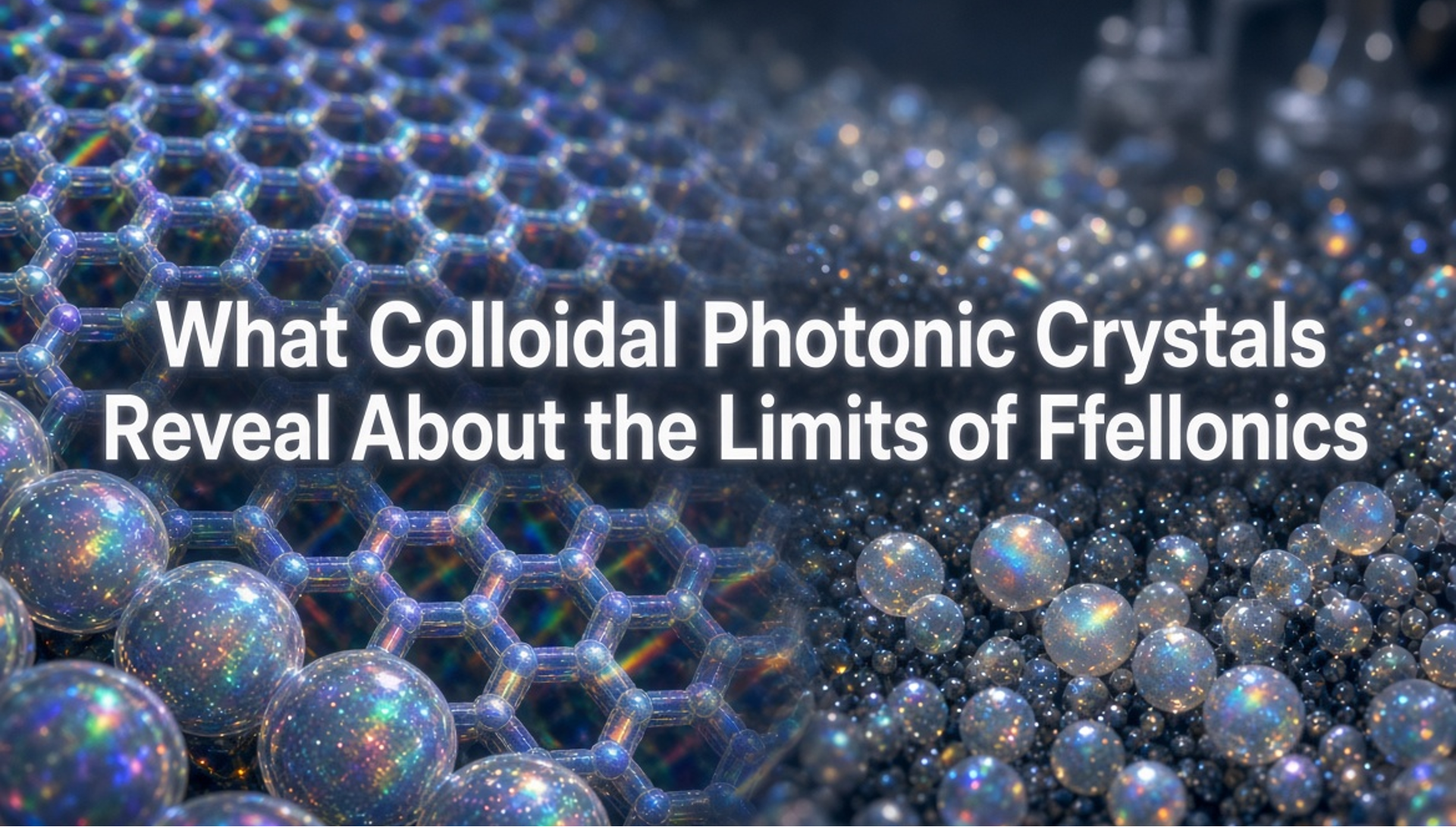
What Colloidal Photonic Crystals Reveal About the Limits of Ffellonics — and Why That Strengthens the Case
What Colloidal Photonic Crystals Reveal About the Limits of Ffellonics — and Why That Strengthens the Case
The 2020 paper "Leveraging Hierarchical Self-Assembly Pathways for Realizing Colloidal Photonic Crystals" (A.B. Rao et al., ACS Nano 14(5), 5348) is a genuine, well-cited piece of colloidal self-assembly research. It does not confirm Ffellonics by matching its full twelve-level hierarchy — a closer look shows it doesn't. What it does, more usefully, is mark out a specific boundary of where Ffellonics' isotropic attachment rule holds and where it stops applying. A theory that correctly predicts both its own reach and the conditions required to escape that reach is in better shape than one that treats every adjacent paper as confirmation, and this is a case worth presenting that way rather than forcing it into the validation mold.
What the Paper Actually Shows
Rao et al. use triblock patchy particles — colloidal spheres engineered with three distinct surface patches that direct specific, non-isotropic binding interactions — to build toward a target structure called the tetrastack lattice, in both cubic and hexagonal polymorphs. Tetrastack is explicitly diamond-inspired: an open, low-coordination lattice (each unit has far fewer nearest neighbors than a close-packed structure) prized in photonics because, unlike dense packings such as FCC, it can support a complete photonic bandgap at experimentally accessible refractive index contrasts.
The assembly proceeds in two stages: the patchy particles first form stable tetrahedral clusters, and those clusters then assemble into the tetrastack lattice. The paper shows this two-stage route succeeds where direct, one-step assembly fails, largely by suppressing five- and seven-membered ring defects that otherwise trap the system in disordered or incorrect structures.
Where Ffellonics' Logic Genuinely Applies
The first stage is a real, close match to Ffellonics' own early levels. Local attachment rules, applied to initially unstructured particles, produce a stable tetrahedral motif as the first robust intermediate — the same structure Ffellonics identifies at Level 3, and for a related reason: among small coordination clusters, the tetrahedron is a highly symmetric, low-strain configuration that a locally energy-minimizing rule naturally favors. This part of the paper is a genuine, specific instance of Ffellonics' generative logic operating in a real colloidal system.
Where It Stops Applying — and Why That's Informative
The second stage is where the mechanisms diverge, and it's worth being precise about how. Ffellonics' own rule is isotropic: identical spheres, symmetric nearest-neighbor attachment, no preferred direction built in. Left to that rule alone, a system of attracting spheres doesn't drift toward an open, low-coordination lattice — it drifts toward the densest, most highly coordinated packing available, which is exactly what Ffellonics' hierarchy describes culminating in at Level 12.
This is precisely why Rao et al. needed patchy, directional particles rather than isotropic ones. To reach tetrastack — a structure that photonics applications specifically want, precisely because it isn't close-packed — the researchers had to engineer anisotropic interaction patches that actively suppress the close-packing outcome isotropic attraction would otherwise produce. The paper's whole design challenge, in other words, presupposes that isotropic, Ffellonics-style attachment pulls toward dense coordination by default, and treats escaping that pull as the hard problem to be solved.
Read this way, the paper isn't a counter-example to Ffellonics so much as indirect confirmation of its central tendency: the default behavior of locally energy-minimizing, symmetric attachment is strong enough, and well-known enough in the colloidal self-assembly field, that an entire body of patchy-particle research exists specifically to design around it when something other than close-packing is wanted. A rule has to be doing real work for defeating it to require this much engineering.
What This Means for Ffellonics' Scope
The accurate, defensible claim is a bounded one: Ffellonics' isotropic attachment rule describes a real default attractor — the pull toward maximal coordination — that colloidal and atomic systems governed by non-directional, symmetric interactions genuinely exhibit, as seen in the Rao paper's own first stage and more fully in the FCC/HCP metal-crystallization and nucleation cases discussed elsewhere in this series. That same body of research also tells us what it takes to leave that attractor: deliberately introduced anisotropy, of the kind patchy particles provide. Ffellonics, as stated, isn't a theory of anisotropic, chemically-directed assembly, and this paper is a useful marker of that boundary rather than evidence the boundary doesn't exist.
Why This Is a Stronger Foundation Than Overreach
A claim that holds only where it's actually tested, and names its own edge accurately, survives scrutiny better than a claim stretched to cover every structurally related paper in the literature. This essay's predecessor treated the Rao paper as "one of the strongest experimental validations yet" of the full twelve-level hierarchy; the actual target structure in that paper shows that claim doesn't hold at the high-coordination end. The version that survives contact with the paper's real findings is narrower — isotropic attachment pulls toward dense coordination, and escaping that pull takes directional engineering — but it's a claim the evidence actually supports, and it leaves Ffellonics' core mechanism more credible, not less, for having a boundary that real research independently confirms.
Comments
No comments yet. Be the first to share your thoughts.