What is a Sphere in Ffellonics?
What Is a Sphere in Ffellonics?
In Ffellonics, the sphere is not merely a geometric object — a ball bearing, a passive unit waiting to be arranged. It is the relational primitive: the simplest entity whose geometry makes structured, symmetric contact possible in three-dimensional space. Everything that follows in the 12-level hierarchy follows from what the sphere is geometrically, before any two spheres have touched.
The Sphere as Relational Primitive
Ffellonics begins with one foundational choice: identical spheres as the basic unit. This choice is not arbitrary. The sphere has three geometric properties that make it the right primitive for a framework built on relation:
Isotropic. A sphere has no preferred orientation, no axis, no face, no edge. Every point on its surface is geometrically equivalent. This means every direction is equally available for contact. The sphere does not privilege any relation over any other — it is maximally open to whatever geometry contact will impose.
Self-contained. Its size and shape are invariant through all interactions. Whatever contacts it forms, whatever structure it joins, the sphere remains what it is. It brings its full geometry to every relation without being altered by it.
Defined by contact potential. An isolated sphere is pure potential — perfectly symmetric, but without direction, coordination number, or structural role. None of those properties belong to the sphere alone. They emerge only through contact with others. The sphere is not defined by what it is in isolation; it is defined by what its geometry makes possible the moment it touches another.
This is the core philosophical claim of the essay, and it is grounded in geometry rather than metaphor: a sphere's isotropy means that contact is the only structurally significant thing that can happen to it. Relation is not something added to the sphere from outside. It is what the sphere's geometry is for.
This is why Ffellonics begins with spheres rather than points, lines, or polyhedra. A point has no surface and cannot make contact in any geometric sense. A line has a preferred axis. A polyhedron already has faces, edges, and vertices — its structure is pre-given rather than emergent. The sphere alone arrives at first contact with no predetermined structure, only the capacity to form one.
The First Contact
Everything in the Ffellonic hierarchy begins with the first symmetric touch between two spheres. Before that moment: two isolated units, each with perfect rotational symmetry and no structural relationship to anything. After it: a bound dyad with a defined axis, a shared contact point, and a constrained set of possible next steps.
This transition — from isolation to first relation — is the ontological threshold of the hierarchy. The first contact does not merely add a bond; it introduces geometry, direction, and developmental possibility where none existed. The entire 12-level sequence is implicit in the local rule that activates at this moment: symmetric nearest-neighbour attachment under free-energy minimisation.
The first contact bears a structural resemblance to what Whitehead calls an actual occasion — a discrete event that brings something genuinely new into existence and from which subsequent structure unfolds. The analogy is structural rather than literal: Whitehead's actual occasions involve a subjective experiential dimension that sphere contact does not. What the two share is the logical form: a discrete relational event that is irreversible, that constitutes a new kind of reality, and that grounds everything that follows.
The Sphere as Carrier of Symmetry Potential
Each new sphere attaches in the position that maximises contacts and preserves the highest achievable global symmetry at that cluster size. It does not impose symmetry — no single sphere contains symmetry as an intrinsic property. Symmetry is not in the sphere; it emerges from the geometry of contact between spheres.
This is what makes the Platonic solid milestones significant. The tetrahedron at Level 3, the octahedron at Level 4, and the icosahedron at Level 5 are not eternal archetypes projected onto matter from outside. They are stable equilibrium configurations — the structures that contact maximisation under symmetric attachment actually produces at those cluster sizes. They arise because the sphere's isotropy and the geometry of three-dimensional space jointly select them as the lowest-free-energy configurations. The solids are discovered by the process, not imposed on it.
From First Contact to Full Coordination
The hierarchy traces a clear developmental arc:
In the early levels, each sphere is part of a small, closed cluster — a finite system with few contacts and high residual symmetry. The geometry is tight and the number of possible attachment positions is small.
Through the intermediate levels, the cluster grows and coordination increases. Each sphere acquires more neighbours; the structure becomes less closed and more extended.
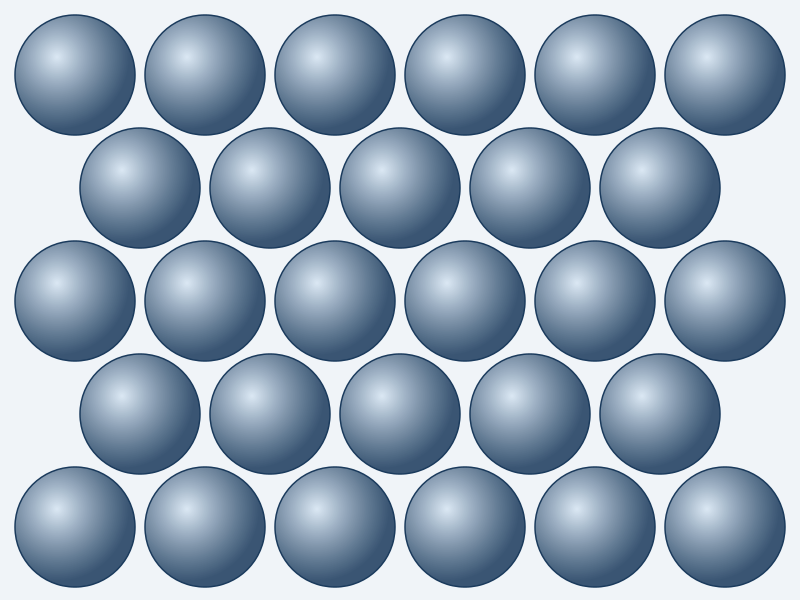
At Level 12 — the FCC/HCP close-packed lattice — each sphere is surrounded by exactly twelve others, the maximum number of simultaneous contacts possible in three-dimensional space. This is the kissing number, proved by Schütte and van der Waerden in 1953. It is the geometric ground state: no further increase in coordination is achievable, and the structure can extend indefinitely without adding new hierarchical levels.
The sphere has moved from a state with no contacts and no structural role to maximum coordination within a stable, infinite lattice. What changed is not the sphere — its size and shape are the same at Level 12 as at Level 1. What changed is its relational situation: from zero contacts to twelve, from undifferentiated potential to fully determined structural position. The sphere's geometric potential, present from the beginning in its isotropy, is fully expressed only at Level 12.
Why This Matters Philosophically
The Ffellonic sphere embodies a specific philosophical claim about the relationship between identity and relation: that a unit's deepest structural properties are not intrinsic to it in isolation but emerge through the geometry of its connections.
An isolated sphere is fully symmetric precisely because it has no relations — every direction is equivalent because none has been selected by contact. The moment contact occurs, symmetry is broken locally and structure begins. Each subsequent contact further specifies the sphere's structural role: its coordination number, its position in the lattice, its contribution to the whole.
This does not mean the sphere loses itself in its relations. At Level 12, each sphere retains its identity — its size, shape, and position are determinate. What it has gained is a fully specified relational context: twelve neighbours, a defined place in the lattice, a coordination geometry that is both individually complete and collectively coherent.
The philosophical point is that these two things — individual identity and maximal relational embeddedness — are not in tension in the Ffellonic hierarchy. They are achieved simultaneously at Level 12. The sphere is most fully determined as an individual precisely when it is most fully embedded in its relations. Isolation is not freedom; it is the absence of structure. Relation is not loss; it is what makes structure possible.
Metaphorical Extension
The sphere's properties — isotropy, self-containment, relational potential — make it a useful model for thinking about any self-contained unit whose deepest capacities are expressed through connection rather than isolation.
This applies, with appropriate caution about the limits of analogy, to any entity that maintains its own coherence while forming stable, mutually supportive connections with others: a person, an organisation, a domain of knowledge. What all such entities share with the Ffellonic sphere is the basic structure: complete in themselves, yet most fully realised through the geometry of their relations.
The analogy is a philosophical lens, not a derivation. Humans are not spheres, and social structures do not obey contact potentials. But the structural insight — that identity and relation are complementary rather than competing — is one the geometry makes vivid, and one that transfers.
An Inversion of Classical Geometry
There is a broader philosophical significance to beginning with spheres that is worth making explicit.
In classical geometry, forms are typically given as starting points — the triangle, the cube, the tetrahedron — and the question is what can be derived or constructed from them. Ffellonics inverts this. It begins with the most structure-neutral entity available and asks what forms emerge from local interaction under a single rule. The answer is that the Platonic solids, the coordination lattices, and the close-packed ground state all arise from the interaction of isotropic units. They are not presupposed. They are produced.
This inversion is philosophically significant. The geometric forms we recognise as fundamental — the tetrahedron, the icosahedron, the hexagonal lattice — are not primary in the Ffellonic account. They are consequences. The primary reality is the sphere and the act of contact. Structure is what relation produces, not what relation presupposes.
The sphere is therefore not a thing that happens to be used as a building block. It is the condition of possibility for the kind of emergence Ffellonics describes — one in which structure arises from relation rather than being given in advance. In this sense, Ffellonics embodies a relational ontology in its most minimal form: the simplest possible unit, the simplest possible rule, and from these alone, the full hierarchy of three-dimensional geometric order.
Conclusion
The sphere is the right primitive for Ffellonics because its geometry makes it the minimal relational unit in three-dimensional space: isotropic enough to form any contact, self-contained enough to maintain its identity through all of them, and structurally inert in isolation in a way that makes the first contact the genuine beginning of everything the framework describes.
The relation is more fundamental than the form. The contact is more fundamental than the solid. From the first touch, everything follows.
Comments
No comments yet. Be the first to share your thoughts.