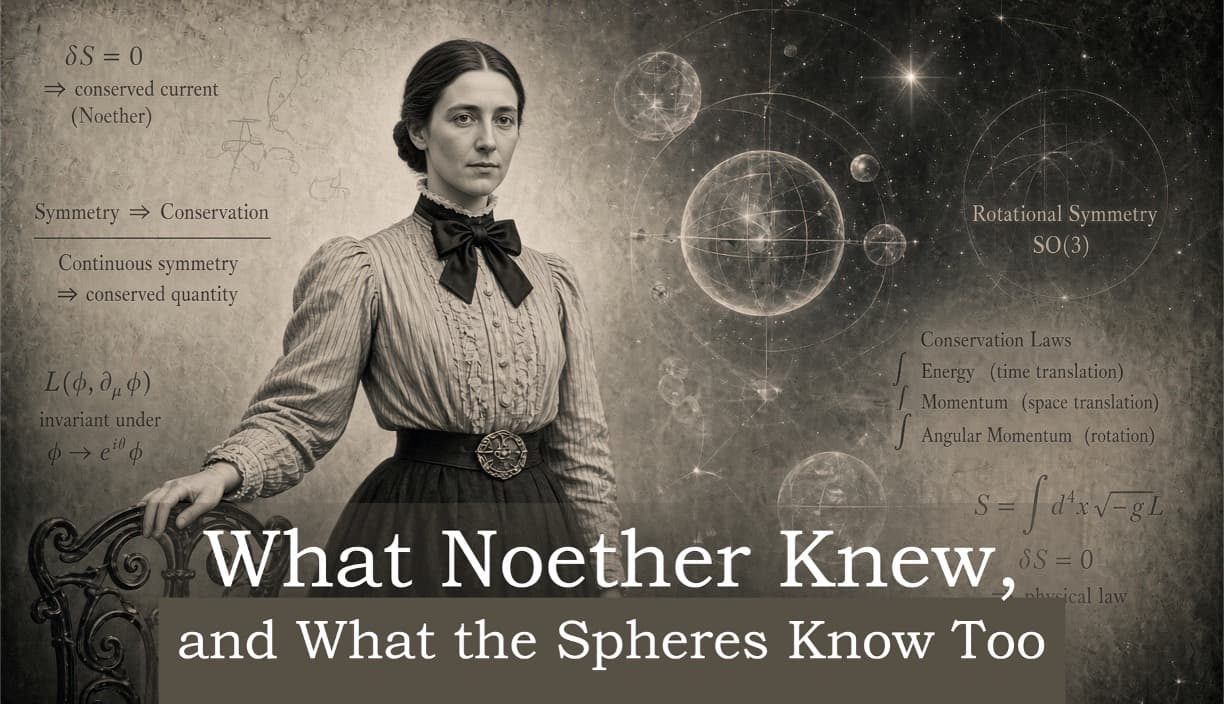
What Noether Knew, and What the Spheres Know Too
In 1918, Emmy Noether proved a theorem that quietly rearranged the foundations of physics. It says, roughly: every continuous symmetry of a physical system corresponds to a conserved quantity. Shift a system forward in time and nothing about its laws changes — that symmetry gives you conservation of energy. Slide it sideways in space and the laws still hold — that gives you conservation of momentum. Rotate it and nothing changes — that gives you conservation of angular momentum. The theorem is not a curiosity. It is the reason physicists trust that energy is conserved at all — not because we've never caught a counterexample, but because we can prove it must be true wherever time-translation symmetry holds.
Noether's insight was that symmetry is not decoration. It is not the pleasing surface a system happens to have. It is structural — it does work. A symmetry is a constraint so deep it manufactures a law.
This is worth sitting with for a moment, because it reframes a question that geometry asks in an entirely different register: why do identical spheres, left to find their own lowest-energy arrangement, settle into configurations of such high and specific symmetry? Ffellonics is built on the observation that spheres in contact don't drift into arbitrary clusters — they organize into a twelve-level hierarchy, from a bare dyad up through progressively richer coordination shells to the densest possible packing, each level maximally symmetric for its coordination number. It is tempting, once you've absorbed Noether's theorem, to reach for it as the explanation. Symmetry is privileged in physics — Noether proved it — therefore symmetry is privileged in sphere packing too. The two phenomena rhyme so cleanly that it feels like they must be the same claim in different clothes.
They are not, and the difference matters more than the resemblance.
Where the analogy breaks
Noether's theorem is a statement about continuous symmetries — symmetries parameterized by a real number that can vary smoothly, like rotating a system by any angle θ between 0 and 2π, or shifting it forward in time by any real-valued interval. The machinery of the theorem depends on this continuity: it works by taking an infinitesimal version of the symmetry and tracking what stays invariant under it. Nudge the system by an infinitesimally small amount, see what's conserved, integrate. That's the proof, in spirit.
The symmetries organizing Ffellonics's hierarchy are not like this. They are discrete point groups — finite sets of specific operations. A tetrahedral cluster of four spheres has a symmetry group with twelve rotational elements, full stop; you cannot rotate it by an "infinitesimally small" amount and have anything invariant, because there is no continuous family of rotations that preserve a tetrahedron's cluster of contacts. The symmetry of an FCC lattice is likewise a discrete crystallographic group, not a Lie group. Noether's proof simply doesn't run on this kind of object. There is no infinitesimal generator to differentiate, no continuous parameter to integrate over.
So the honest thing to say is: Noether's theorem does not predict, generate, or explain the twelve-level hierarchy. Reaching for it as a direct mechanism would be a category error — borrowing the authority of a famous theorem to cover a gap it was never built to fill. If Ffellonics is going to claim a relationship to Noether, it has to be a more modest one than "this is Noether's theorem applied to spheres."
Where a real kinship remains
But something does survive the correction, and it's worth being precise about what.
Noether's theorem is a theorem about variational principles. Physical trajectories in classical mechanics are the ones that extremize an action — that make a certain integral over the system's history as small (or stationary) as possible, subject to the dynamics. Noether's proof works by relating symmetries of that action to conserved quantities of the resulting motion. The theorem lives inside a larger mathematical world: the calculus of variations, the study of systems that arrange themselves according to some extremal principle.
Ffellonics's hierarchy also lives inside that world. The claim is that spheres settle into their coordination shells by minimizing free energy — another extremal principle, structurally the same kind of claim as "the physical trajectory extremizes the action." Different objective function, different configuration space, same underlying logic: the realized state is not arbitrary; it is the one singled out by an optimization. And in both cases, symmetry turns out to matter for a reason that isn't coincidental. In Noether's world, symmetry of the action is what produces the conserved quantity. In Ffellonics's world, symmetry is not proven to be produced by the minimization in the same rigorous sense, but empirically, the free-energy minima keep landing on the most symmetric available configuration for each coordination number — as though extremization and symmetry are pulling in the same direction, even without a Noether-grade proof connecting them.
That's the honest kinship: not a shared theorem, but a shared shape of explanation. Both are cases where asking a system to be optimal, in some precise sense, turns out to privilege symmetric answers. Physics has one rigorous account of why that happens for continuous symmetries in dynamical systems. Ffellonics is documenting that the same pattern — optimality favoring symmetry — shows up again in a completely different mathematical setting: static, discrete, geometric. Noether tells you why it must happen there. Ffellonics is, so far, an empirical and geometric observation that it also happens here — a companion phenomenon in search of its own foundational proof, not an inheritance from Noether's.
The harder objection
A skeptic might say this whole comparison is too generous — that "extremal principles sometimes favor symmetric solutions" is such a broad, soft observation that it's compatible with almost anything, and dressing it up with Noether's name imports rigor the argument hasn't earned. This is a fair challenge, and worth taking seriously rather than waving off. The calculus of variations does not universally favor symmetry; there are plenty of extremal problems whose solutions are lopsided, degenerate, or symmetry-breaking (a ball resting in an asymmetric bowl still finds the single lowest point, symmetric or not, and many free-energy landscapes have their global minimum at a decidedly unsymmetric configuration). So the mere fact that a system is optimizing something proves nothing about symmetry on its own.
What can be said more carefully is narrower: for a specific configuration space — identical spheres, fixed contact constraints, a coordination number held constant — symmetric arrangements are frequently the unique or dominant minimizers, because asymmetric arrangements of otherwise-identical, interchangeable units tend to leave "slack" that a small perturbation toward symmetry can relax further. That's a real, checkable geometric claim, and it's the actual load-bearing content behind Ffellonics's hierarchy — not a philosophical inheritance from Noether, but a specific structural fact about packing problems that deserves its own proof, level by level, rather than a borrowed theorem's blessing.
What this is worth, stated plainly
Noether's theorem and Ffellonics's hierarchy are not the same claim in two costumes. One is a proven law of continuous dynamical systems; the other is an empirical and geometric pattern in discrete static configurations, still owed a comparably rigorous foundation of its own. What they share is a conviction, expressed in two different mathematical languages, that symmetry is not what a system merely happens to display — it is frequently what a system is compelled toward when required to be optimal. Noether proved that compulsion, once and for all, for the continuous case. Ffellonics is staking out the discrete, geometric case as a place where the same compulsion appears to operate, and inviting the proof that would put it on equally solid ground.
That is a smaller claim than "Noether's theorem explains Ffellonics." It is also, I think, a more interesting one — because it leaves the actual work still to be done.
Comments
No comments yet. Be the first to share your thoughts.